Background and research question
The context behind the question. Follow the biological rationale, then use the evidence guide to distinguish intention from observation.
The problem the project explores
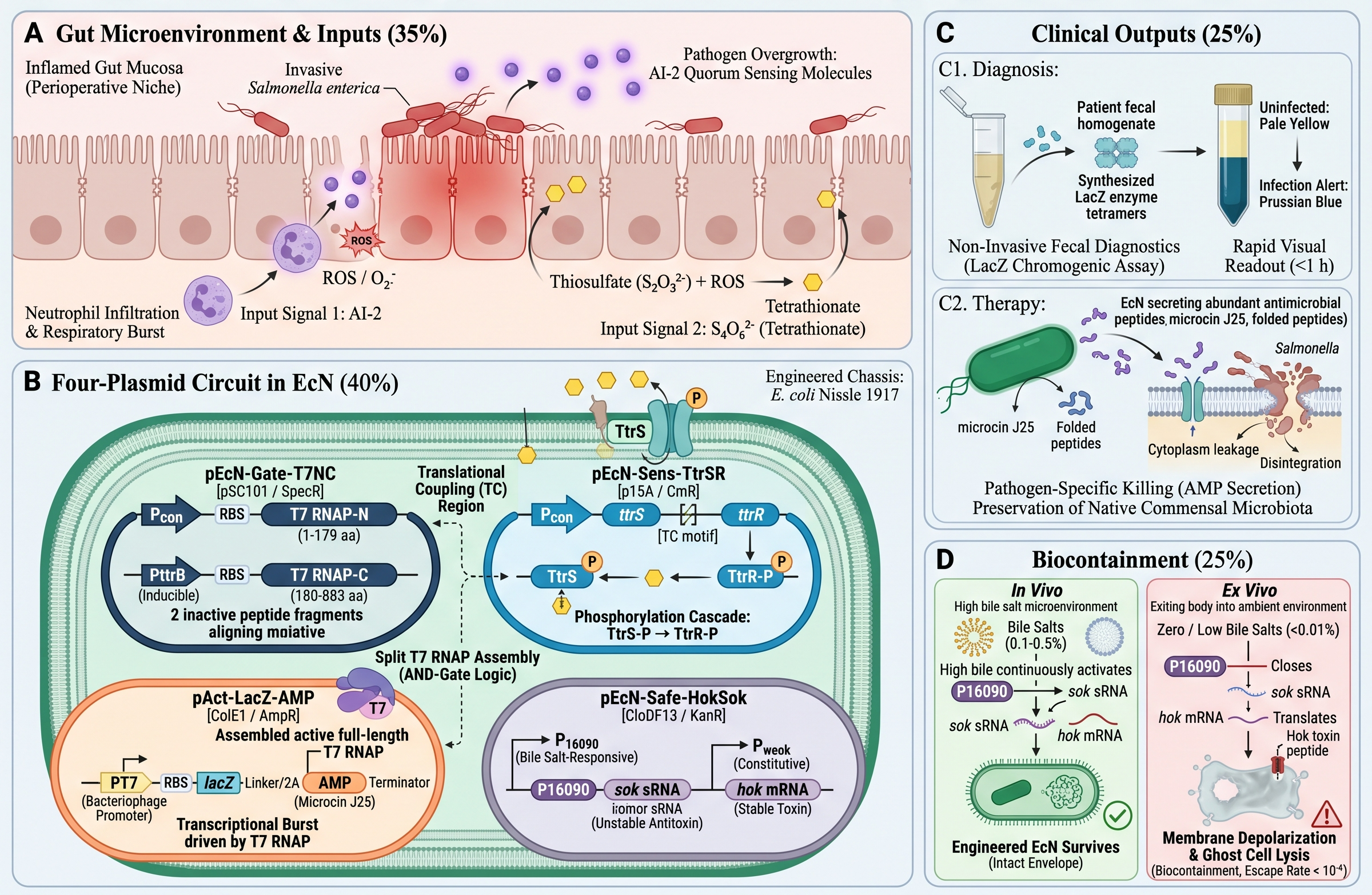
Our project addresses intestinal dysbiosis and the expansion of enteric pathogens such as Salmonella. We propose an engineered probiotic chassis that could sense two environmental cues and produce a visible reporter signal in a controlled laboratory model. This is a research concept: our experiments do not test patients, clinical samples, or diagnostic accuracy.
Why use two inputs?
AI-2 is a bacterial interspecies signaling molecule. Tetrathionate can become available in inflamed intestinal environments and can support Salmonella respiration. We hypothesise that combining a quorum-sensing-associated input with tetrathionate could make the output more selective than responding to either cue alone.
The experimental input called “Salmonella culture filtrate” is not purified AI-2. It contains AI-2 together with other soluble products of bacterial growth. A direct AI-2 concentration measurement is not available for this assay. We therefore use the term culture-filtrate proxy and do not treat the filtrate percentage as an AI-2 concentration.
Research question
In an EcN laboratory chassis, does the combination of Salmonella culture filtrate and tetrathionate produce a stronger LacZ-associated colorimetric readout than either input alone, and what evidence supports the other proposed system functions?
This question separates our in-vitro measurements from the wider clinical motivation. The available evidence covers tetrathionate tolerance and reporter expression, a cross-induction matrix, a crystal-violet biofilm assay, and an L-929 cell assay. It does not establish diagnostic sensitivity in stool, pathogen-specific treatment, safety in a host, or reliable containment after environmental release.
Why this belongs in an evolution competition
We organised our engineering work into eleven DBTL cycles. These cover design and testing rather than completed directed-evolution rounds. Our current research record does not establish a mutagenesis or diversified library, selection criterion, genotype–phenotype lineage, or ancestor-versus-improved comparison. See the Evolution perspective for the evidence needed to describe an evolution result.
References
Our scientific rationale draws on studies of inflammation and tetrathionate in the gut, AI-2 signaling, synthetic split-T7 logic, and engineered live biotherapeutics. The reference list is collected in Data and references.