Begin with curiosity
Education becomes meaningful when a learner can move from “I have heard that word” to “I can explain it, question it and share it.”
Our programme connects children, school students, university peers and community residents. Different audiences need different starting points, so our activities follow four stages: Explore → Understand → Engage → Connect.
 01
01Explore
Notice something. Ask a question.
 02
02Understand
Connect the idea to an explanation.
 03
03Engage
Discuss, question and participate.
 04
04Connect
Keep exploring and share what you learn.
The four stages organise the education programme; full activity records and photographs remain available below.
A path into the science
| Stage | Starting point | Formats in our record |
|---|---|---|
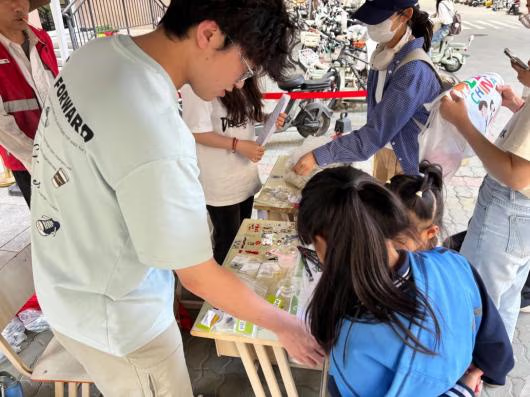
| Explore | What can I see, touch or ask? | Activities for children, Petri-dish artworks and guided laboratory visits |
| Understand | How does this idea work? | Visual explanations, campus booths and school sessions |
| Engage | What do I think about it? | Questions, quick voting, discussion and feedback |
| Connect | How can I keep learning or share it? | Reusable materials, multilingual leaflets and peer exchange |
Programme reach
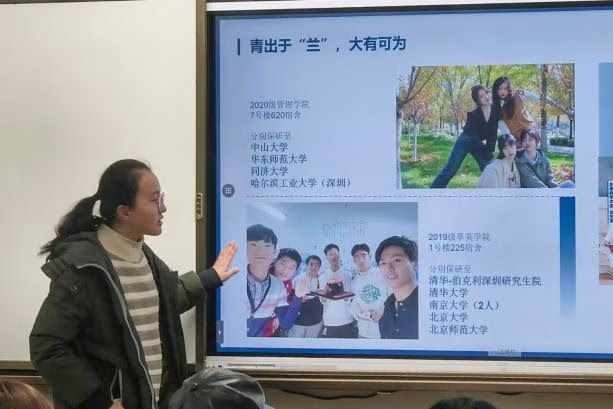
Our county-level programme reached seven schools and 423 students. An activity for children involved 48 pupils, and the leaflet series covers 15 languages. These figures refer to different parts of the programme and should not be added into a unique-participant total.
The complete record includes activities at the Medical and Yuzhong campuses, community engagement, school exchanges, academic discussions, material development and evaluation. Read the full education record →
Feedback changed the format
Feedback led to three practical changes:
- We used a two-stage, colour-coded diagram to distinguish signal recognition from biological response.
- We added anonymous questions and quick voting to encourage discussion in school sessions.
- We simplified the wording and layout of text-heavy leaflets so readers could find key points more easily.
How we think about impact
Reach: Could people access the activity? Learning: Could they explain the idea? Participation: Could they ask questions and express a view?
Attendance and satisfaction alone do not answer all three. The full record describes how we evaluated the programme and the limits of that evaluation.