

qPCR Evaluation
We used the difference between the Cq values obtained with the qPCR-A-F/-R primer pair and those obtained with the qPCR-AmpR-F/-R primer pair to obtain a relative measure of the DNA cleavage efficiency of ISCro4. For each variant, three independent colonies were randomly selected and cultured overnight. The cultures were then diluted to normalize the OD600, and two technical replicates were performed for each sample.
A225S Positive Hit
We additionally included E60Q as a negative control, as this mutation has previously been reported to abolish the DNA cleavage activity of ISCro4 [8]. Interestingly, we found that, with the exception of A225S, the other mutations reduced the activity of ISCro4. Notably, the A225S variant exhibited a higher Cq-value difference than the ISCro4 control, indicating that a greater amount of the target DNA had been deleted. Thus, A225S was identified as a positive hit, corresponding to a hit rate of 1/10.
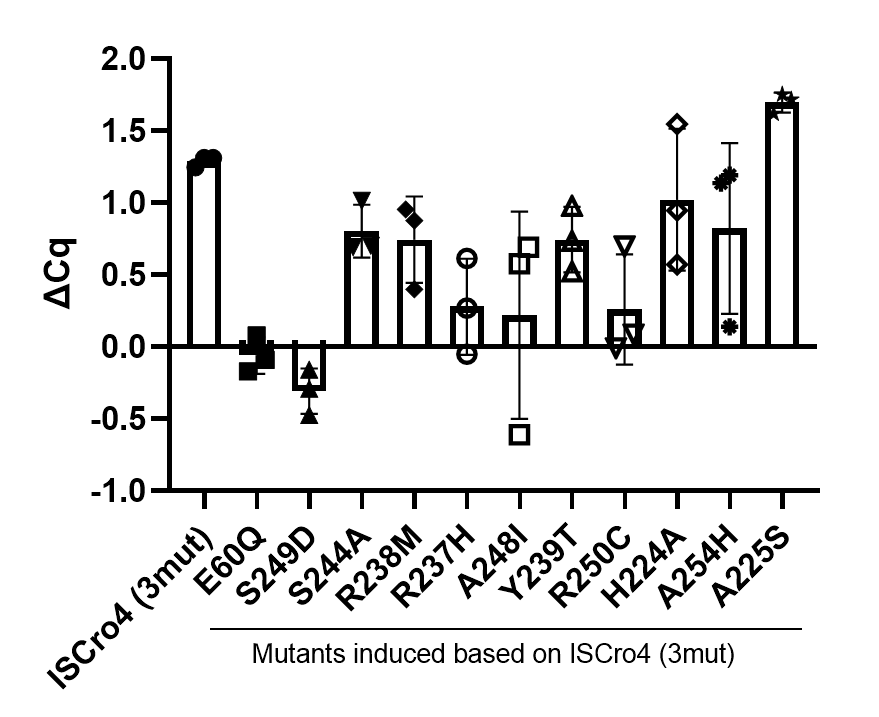
Fig. qPCR-based evaluation of ISCro4 DNA deletion efficiency. The ΔCq means difference in Cq values between the qPCR-A-F/-R and qPCR-AmpR-F/-R primer pairs. It was used to relatively quantify the DNA deletion efficiency of ISCro4 variants. Three independent colonies were randomly selected for each variant and cultured overnight. Cultures were diluted to normalize OD600 before qPCR analysis, with two technical replicates performed for each sample.
Directed Evolution Outcome
In the context of directed evolution, obtaining one positive variant from a screening set of only ten candidates is a meaningful outcome. Importantly, the ISCro4 variant used as the starting point already contained three mutations relative to the wild-type protein, making epistatic effects a potentially important factor in determining the impact of additional mutations. Furthermore, the sequence–function space of proteins is extraordinarily large, with an enormous number of possible sequence combinations. Against this background, identifying an improved variant by screening only ten candidates demonstrates that our AI-assisted mutation selection strategy can efficiently explore the sequence space and identify potentially beneficial mutations.