

Directed Evolution and AI Assistance
Directed evolution of proteins can be used to create truly remarkable synthetic biology tools, such as plastic-degrading enzymes, fluorescent proteins, and gene-editing tools. Its core idea is to "replay natural selection in a test tube": a vast mutant library is constructed through random mutagenesis, DNA shuffling, or saturation mutagenesis, and then iterative cycles of "mutation–screening–re-mutation" are carried out according to a predefined functional goal (such as higher catalytic activity, brighter fluorescence, or broader substrate compatibility), allowing a naturally mediocre protein to evolve continuously in the direction we set [1]. From engineering PET hydrolases to accelerate plastic degradation [2], to evolving GFP into a series of brighter and more stable fluorescent proteins [3], and to the directed evolution of Cas9 variants and large serine recombinases [4, 5] to expand the target range and efficiency of genome editing, this strategy has proven again and again that we do not need to fully understand every detail of a protein in order to tame it into an ideal tool.
This technology is full of potential, yet it also faces certain bottlenecks—or professional barriers. First, experimental design is itself an interdisciplinary discipline: the mutagenesis strategy (error-prone PCR, saturation mutagenesis, recombination) must be matched to the "fitness landscape" of the target function, and the library size must be carefully balanced against screening throughput; otherwise, one either fails to find positive clones or is drowned in a sea of negative results. Second, every round of evolution involves primer design, vector construction, transformation and colony counting, high-throughput assays, and sequencing data analysis—a statistical or operational error at any single step can render weeks of effort futile. More importantly, this knowledge is scattered across hundreds of papers, laboratory manuals, and bioinformatics tools. For beginners without systematic training or expensive equipment, the barrier to entry is extremely high—which is precisely why so many high school students and amateur enthusiasts yearn for directed evolution yet dare not take the first step.
Here, as a group of biotechnology enthusiasts still in high school, we demonstrate how AI agents—Biomni in particular—can help us break through these knowledge barriers and successfully complete our first directed evolution journey, yielding a more efficient large-fragment DNA editing tool. Throughout the project, Biomni served as our "on-board mentor": it helped us systematically search and organize the literature on the evolutionary history and key residues of our target protein, guided us in designing the mutagenesis strategy and screening scheme, predicted the effects of mutations on protein structure and function, and assisted us with sequence alignment and fitness analysis of our sequencing data. With its guidance, we were able to plan each round of iteration the way a professional laboratory would, avoiding a great deal of trial-and-error waste of time and reagents. In the end, we successfully evolved a variant of the ISCro4-based large-fragment DNA editing tool with substantially improved activity, achieving a considerable increase in editing efficiency over the already-engineered parent variant. This experience has convinced us that AI agents are placing the "admission ticket" to cutting-edge protein engineering into the hands of more young enthusiasts, so that curiosity is no longer limited by experience or resources.
Project design with the help of Biomni
Directed evolution is an advanced and technically demanding field that requires substantial prior knowledge, specialized expertise, and experimental resources. As a high school student research group, we initially lacked many of the necessary skills and resources to conduct such work.
At a point when we were unsure how to proceed, we noticed the rapid emergence of AI agents over the past two years, which offered a potential way to overcome some of these limitations. We chose Biomni, an AI agent specifically developed for biological research [10], as our research assistant. With guidance from Biomni, we explored the directed evolution of ISCro4, a tool with the ability to mediate large-fragment DNA recombination. The following describes our approach and the evolutionary process we carried out with its assistance.
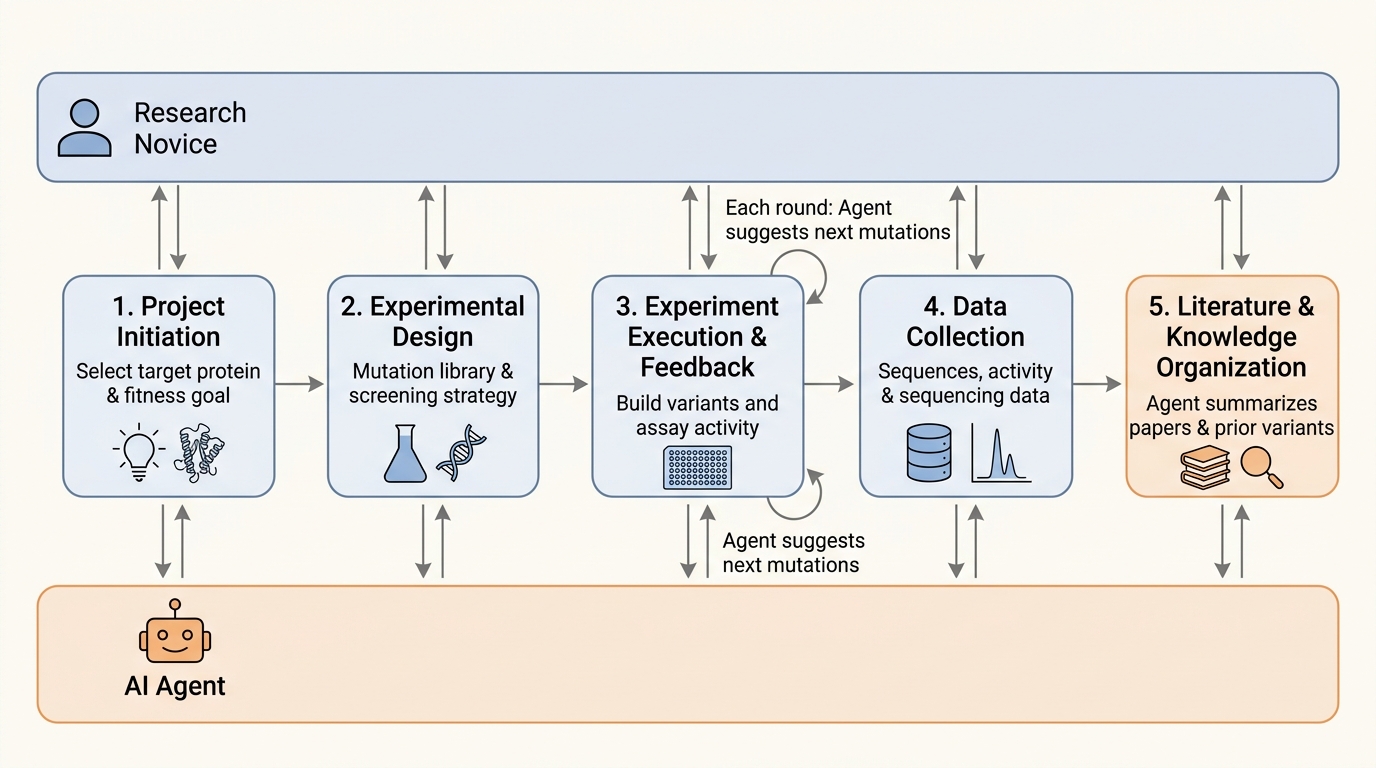
Fig. 1. Agent-enabled workflow and progress of the directed evolution project. Agents were involved throughout the research process, from project conception and experimental design to data interpretation and scientific writing. By integrating AI agents into the research workflow, this framework allows researchers with limited prior experience to effectively undertake complex directed evolution projects, potentially broadening the accessibility and impact of directed evolution technologies.
We first set out to define our research topic by reviewing the existing literature and seeking guidance from Biomni. More than half of our team members were particularly interested in gene-editing technologies. When we entered this interest into a web search, we encountered a number of recently reported technologies for large-fragment DNA editing and recombination, including prime editing-based technology [6], IS621 [7] and ISCro4 [8, 9].
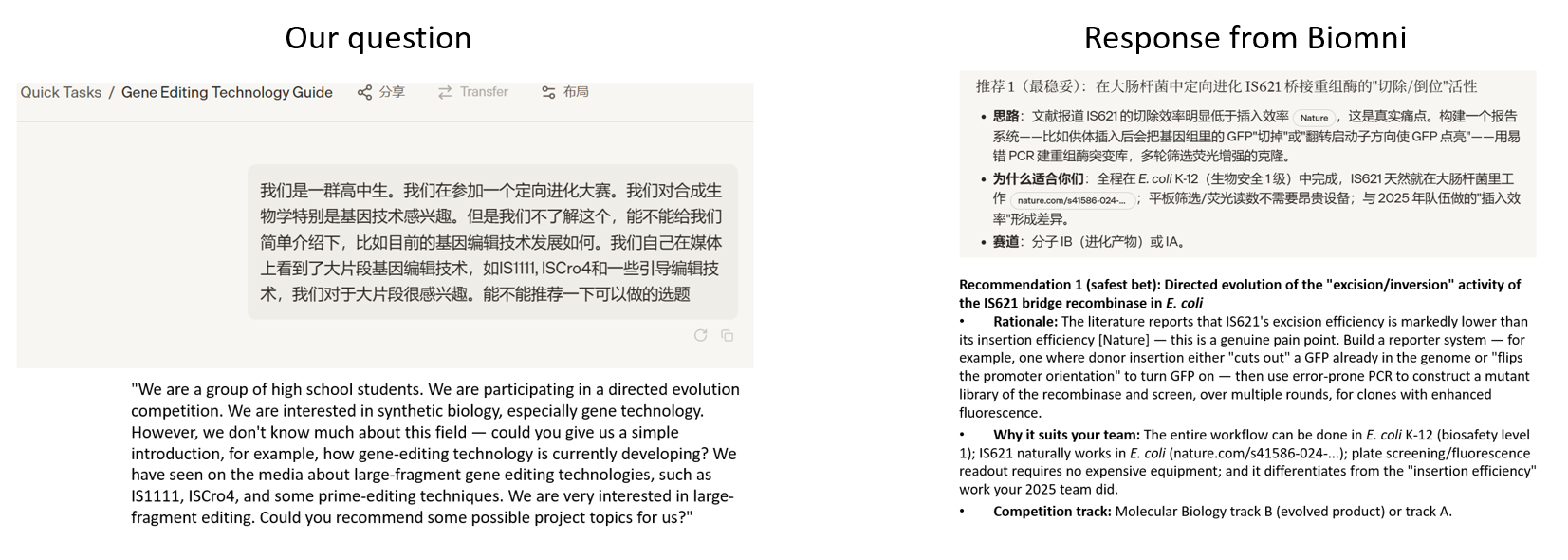
Fig. 2. Project initiation through dialogue with the AI agent Biomni. We first reviewed relevant information available online and communicated our research interests to Biomni. Based on these inputs, Biomni autonomously explored the relevant literature and information and proposed an experimentally feasible research direction.
We then described our interests, our background, and our limitations to Biomni. At first, we expected that Biomni would simply provide us with some general background information, introduce the relevant technologies, or perhaps even tell us that the project was beyond our capabilities. What it actually provided was far beyond our expectations. Rather than simply giving us a broad introduction to the field, Biomni recognized the potential of our research interests, suggested that our choice of topic was promising, and presented us with multiple possible research directions. It helped us compare different systems and identify questions that could potentially be addressed through experimentation. Due to space limitations, we show only one representative part of its response here.
Based on Biomni’s suggestions, together with our own subsequent literature review and verification, we ultimately chose ISCro4, a large-fragment DNA recombinase, as our target for directed evolution. Our goal was to investigate whether its recombination activity could be further improved, particularly in Escherichia coli, and to explore whether an AI agent could help us navigate a technically demanding area of biological research that would otherwise have been difficult for a high school student team to enter.
![Fig. 3. Mechanism of action of ISCro4. ISCro4 mediates the RNA-guided, targeted integration of donor DNA fragments into genomic target sites [8, 9]. First, the guide RNA (gRNA) recognizes and base-pairs with the complementary target DNA sequence, directing the ISCro4-associated complex to the target site. The donor DNA is subsequently engaged by the ISCro4 system, facilitating coordinated DNA recombination between the donor and target sites and ultimately enabling the precise insertion of the designed DNA fragment into the target genomic locus. This mechanism highlights the potential of ISCro4 as a platform for targeted delivery and integration of relatively long DNA fragments, providing an alternative strategy for genome engineering that does not rely on conventional homology-directed recombination.](/2026_VCA-Prudens/assets/report-20261004/design-15-0.png)
Fig. 3. Mechanism of action of ISCro4. ISCro4 mediates the RNA-guided, targeted integration of donor DNA fragments into genomic target sites [8, 9]. First, the guide RNA (gRNA) recognizes and base-pairs with the complementary target DNA sequence, directing the ISCro4-associated complex to the target site. The donor DNA is subsequently engaged by the ISCro4 system, facilitating coordinated DNA recombination between the donor and target sites and ultimately enabling the precise insertion of the designed DNA fragment into the target genomic locus. This mechanism highlights the potential of ISCro4 as a platform for targeted delivery and integration of relatively long DNA fragments, providing an alternative strategy for genome engineering that does not rely on conventional homology-directed recombination.
Protein directed evolution with the help of Biomni
After establishing and validating the testing system, we officially moved on to the directed evolution of ISCro4. Previous studies of ISCro4 had generated a deep mutational scanning (DMS) dataset [8, 11], providing a valuable resource for identifying mutations that could potentially enhance its activity. Our goal was to use this existing dataset to identify promising mutations and further improve the efficiency of ISCro4. However, interpreting these mutations from a structural perspective was challenging for us due to our limited background in structural biology. We therefore turned to Biomni once again and asked it to help us select 10 candidate mutation sites for subsequent experimental validation.
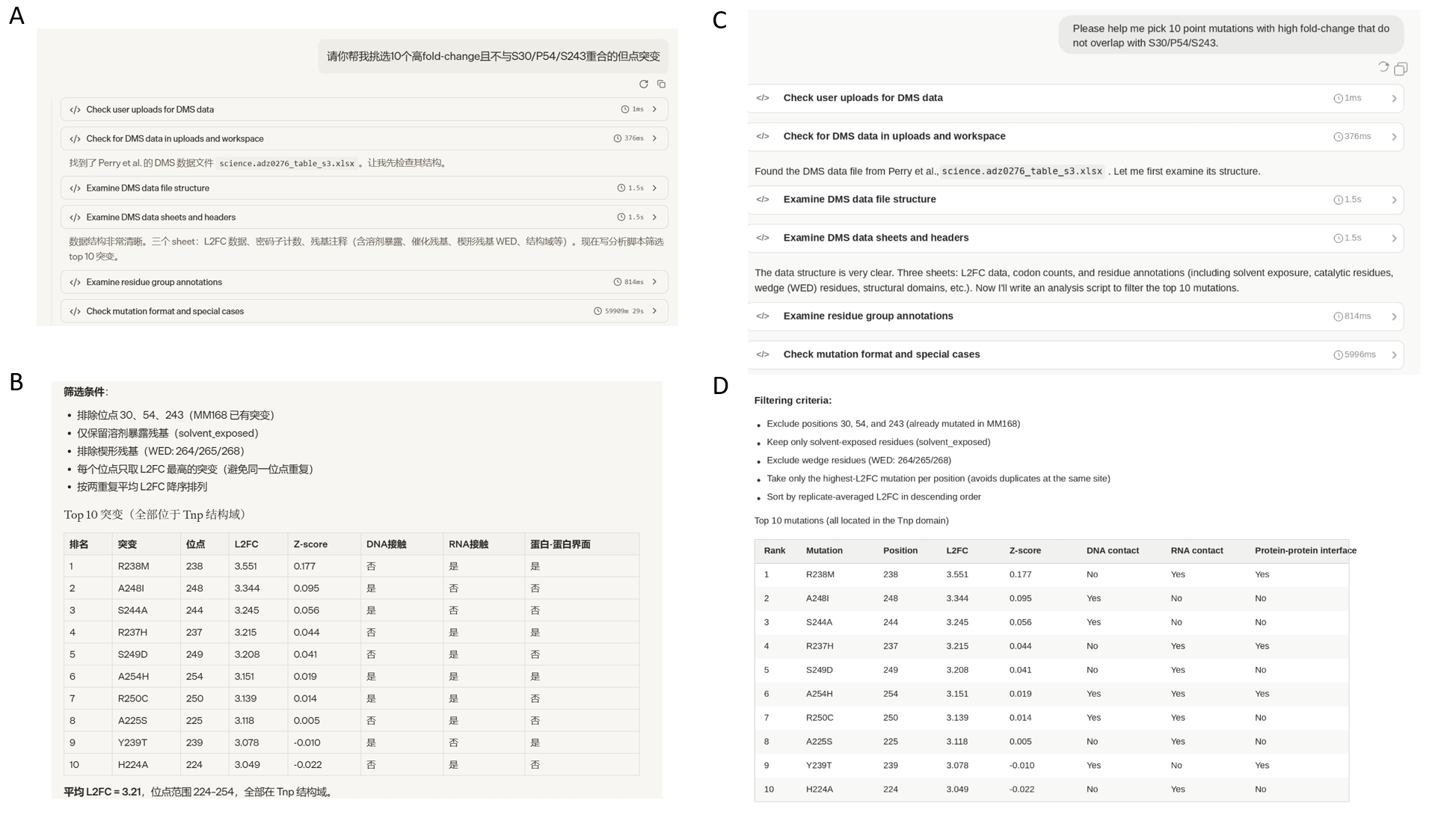
Fig. 4. Biomni-assisted selection of mutation sites. We asked Biomni to select 10 highly active mutations from previously reported datasets, while excluding the previously identified positions S30, P54, and S243. (A) Original conversation with Biomni. (B) Original output generated by Biomni. (C) English translation of our conversation. (D) English translation of Biomni’s output.
To introduce these mutations, we next needed to design the corresponding primers. With a large number of mutants to construct and the need for careful primer design, this quickly became a tedious and time-consuming step. Once again, we turned to Biomni for help. It efficiently designed the primers for all of our mutants, allowing us to move on to the next stage of the experiment.
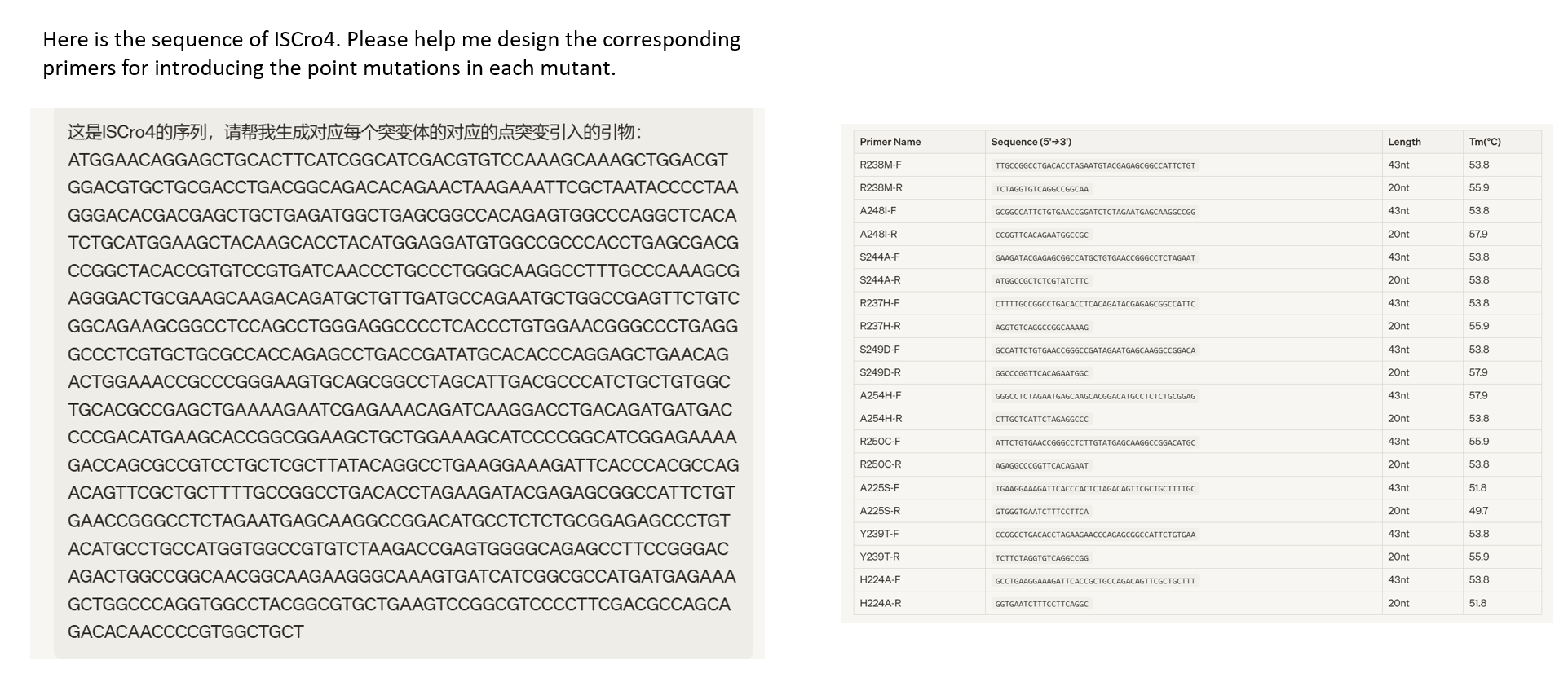
Fig. 5. Biomni-assisted primer design. We asked Biomni to design primers for introducing the selected mutations.
Reference
1. M. S. Packer, D. R. Liu, Methods for the directed evolution of proteins. Nature Reviews Genetics 16, 379–394, (2015).
DOI: https://doi.org/10.1038/nrg3927
2. H. Lu et al., Machine learning-aided engineering of hydrolases for PET depolymerization. Nature 604, 662–667, (2022).
DOI: https://doi.org/10.1038/s41586-022-04599-z
3. A. Crameri, E. A. Whitehorn, E. Tate, W. P. Stemmer, Improved green fluorescent protein by molecular evolution using DNA shuffling. Nature Biotechnology 14, 315–319, (1996).
DOI: https://doi.org/10.1038/nbt0396-315
4. J. H. Hu et al., Evolved Cas9 variants with broad PAM compatibility and high DNA specificity. Nature 556, 57–63, (2018).
DOI: https://doi.org/10.1038/nature26155
5. S. Pandey et al., Efficient site-specific integration of large genes in mammalian cells via continuously evolved recombinases and prime editing. Nature Biomedical Engineering 9, 22–39, (2025).
DOI: https://doi.org/10.1038/s41551-024-01227-1
6. A. V. Anzalone et al., Search-and-replace genome editing without double-strand breaks or donor DNA. Nature 576, 149–157, (2019).
DOI: https://doi.org/10.1038/s41586-019-1711-4
7. M. G. Durrant et al., Bridge RNAs direct programmable recombination of target and donor DNA. Nature 630, 984–993, (2024).
DOI: https://doi.org/10.1038/s41586-024-07552-4
8. N. T. Perry et al., Megabase-scale human genome rearrangement with programmable bridge recombinases. Science 391, eadz0276, (2026).
DOI: https://doi.org/10.1126/science.adz0276
9. O. Pelea et al., Programmable genome editing in human cells using RNA-guided bridge recombinases. Science 391, eadz1884, (2026).
DOI: https://doi.org/10.1126/science.adz1884
10. K. Huang et al., Biomni: A General-Purpose Biomedical AI Agent. bioRxiv 2025.05.30.656746, (2025).
DOI: https://doi.org/10.1101/2025.05.30.656746
11. D. M. Fowler, S. Fields, Deep mutational scanning: a new style of protein science. Nature Methods 11, 801–807, (2014).
DOI: https://doi.org/10.1038/nmeth.3027