

Project debug with the help of Biomni
![Fig. 1. Plasmid design and validation for functional characterization of ISCro4. (A) Plasmid designed for ISCro4 expression. The plasmid contains an ISCro4 donor site preceded by the strong J23119 promoter. Based on a previously reported variant [8], ISCro4 (S30T/P54Q/S243H) was selected for our experiments and is hereafter referred to simply as ISCro4 for convenience. (B) Plasmid designed for functional validation. This plasmid contains a chloramphenicol-resistance gene, a guide RNA, and the designed target site. If ISCro4-mediated integration occurs, the donor and target sites are expected to recombine, resulting in expression of the chloramphenicol-resistance gene. (C) Sequencing results of the two plasmids. The functional-validation plasmid was successfully constructed, whereas repeated attempts to construct the ISCro4 expression plasmid were unsuccessful.](/2026_VCA-Prudens/assets/report-20261004/engineering-2-0.png)
Fig. 1. Plasmid design and validation for functional characterization of ISCro4. (A) Plasmid designed for ISCro4 expression. The plasmid contains an ISCro4 donor site preceded by the strong J23119 promoter. Based on a previously reported variant [8], ISCro4 (S30T/P54Q/S243H) was selected for our experiments and is hereafter referred to simply as ISCro4 for convenience. (B) Plasmid designed for functional validation. This plasmid contains a chloramphenicol-resistance gene, a guide RNA, and the designed target site. If ISCro4-mediated integration occurs, the donor and target sites are expected to recombine, resulting in expression of the chloramphenicol-resistance gene. (C) Sequencing results of the two plasmids. The functional-validation plasmid was successfully constructed, whereas repeated attempts to construct the ISCro4 expression plasmid were unsuccessful.
When we obtained this result, we were deeply frustrated. Without successfully obtaining the desired plasmid, we could not proceed to the next stage of our experiment. We therefore tried to troubleshoot the problem using the approaches we were familiar with. We reduced the amount of template DNA, treated the reaction with DpnI to eliminate the parental plasmid, and screened additional colonies in the hope that the desired construct might still be recovered. However, none of these strategies resolved the problem.
With few options left, we decided to consult Biomni. Its response surprised us. Rather than simply suggesting another round of cloning or further optimization of the existing protocol, Biomni pointed out several factors that we had completely overlooked, including the potential toxicity of the construct, the properties of the promoter, and the characteristics and compatibility of individual genetic elements. These were not obvious considerations to us because they require knowledge that is highly specific to molecular cloning and biological engineering. Without experience in this particular area, it is difficult to know which seemingly unrelated factors may determine whether a construct can actually be obtained.
What was even more striking was that these considerations had not emerged during our own troubleshooting process. We had also consulted a teacher who was helping us with the project, yet these potential issues were not identified at that stage either. This experience made us realize that the value of an AI scientific agent is not simply that it can provide another protocol or search for an answer. More importantly, it can connect dispersed pieces of domain knowledge and bring expert-level considerations into the problem-solving process, even when the user does not yet know which questions should be asked.
For us, this was particularly meaningful as a high school research group. At the beginning of the project, we lacked much of the specialized knowledge and experimental experience normally required for directed evolution and molecular engineering. Biomni did not replace the need for experimental work, but it helped us recognize hidden variables that we would otherwise have had little chance of considering. In this sense, scientific agents such as Biomni may have the potential to make advanced biological techniques more accessible by lowering the knowledge barrier between researchers and specialized experimental expertise.
Based on Biomni’s suggestions, we replaced the promoter upstream of ISCro4 with a T7 promoter. This design allowed us to introduce the completed plasmid into E. coli strains carrying the T7 RNA polymerase gene, such as BL21(DE3), and subsequently induce ISCro4 expression to directly assess its activity.
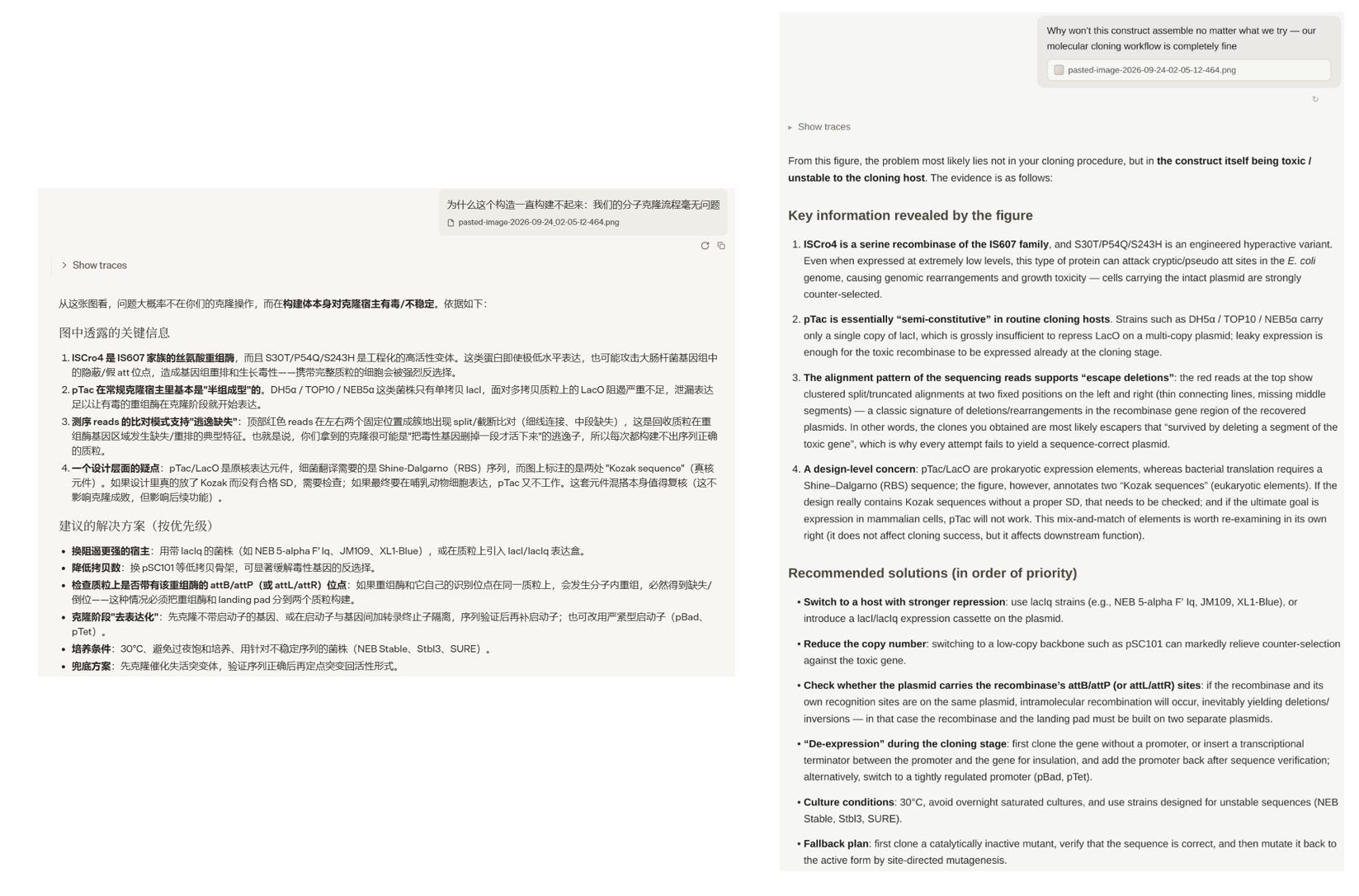
Fig. 2. Biomni-assisted debugging reveals previously overlooked factors. We shared our experimental results and observations with Biomni and asked it to diagnose the failure in plasmid construction. Biomni proposed several potential contributing factors, all of which were biologically plausible and consistent with our results, but none of which we had initially considered.
At the same time, to accelerate the experimental workflow, we consolidated the donor site, target site, guide RNA, and ISCro4 expression cassette into a single plasmid, thereby simplifying the plasmid construction and subsequent functional validation process. When ISCro4 is active, the terminator sequence located between the WT Donor and WT Target sites is expected to be excised, allowing expression of the downstream chloramphenicol-resistance gene and thereby conferring chloramphenicol resistance to the bacterial host.
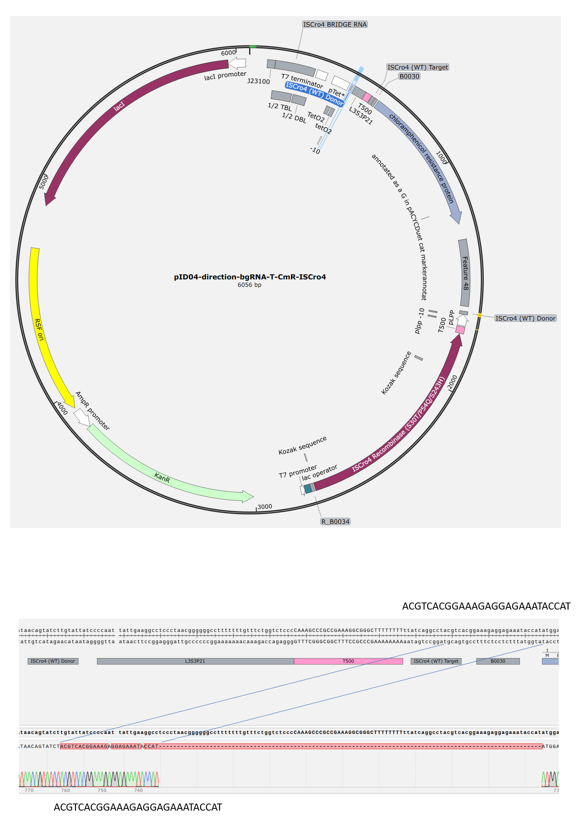
Fig. 3. Revised plasmid design and sequencing validation. We redesigned the plasmid to place ISCro4, the antibiotic-resistance gene, the guide RNA, and its target site on a single plasmid. After plasmid construction, we performed sequencing to assess whether ISCro4 was functional.
To our surprise, the sequencing results revealed that ISCro4 had already mediated the excision event. In our original design, the DNA sequence between the ISCro4 donor and target sites was expected to be excised. Consistent with this prediction, the sequencing results showed the expected rearrangement of the plasmid, providing evidence that ISCro4 was functionally active.
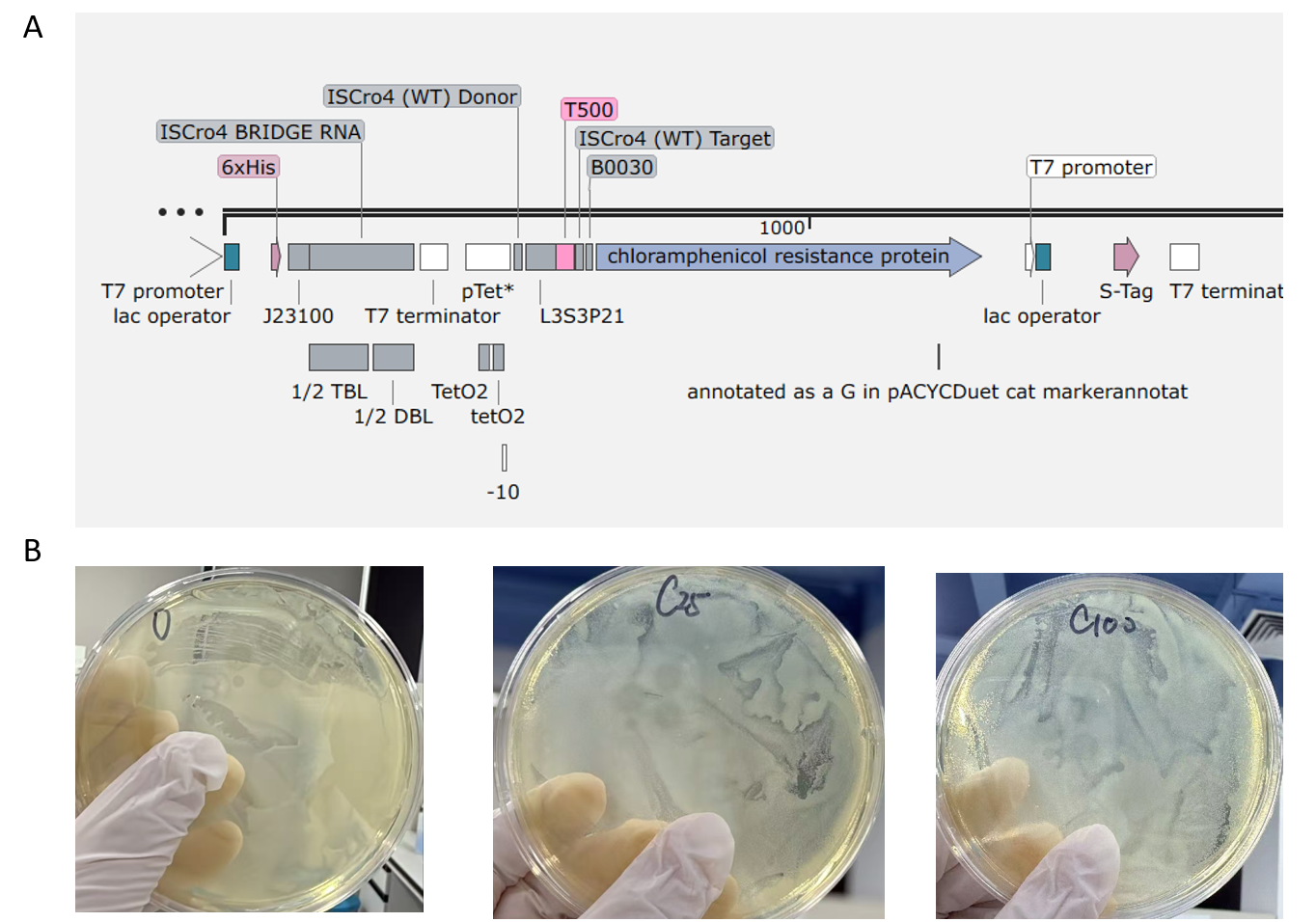
Fig. 4. Antibiotic-resistance assessment before and after ISCro4 activity. (A) Plasmid design. The ISCro4 expression cassette was removed from the plasmid shown in Fig. 6 to assess antibiotic resistance in the absence of ISCro4 activity. (B) Bacterial growth was assessed on LB agar plates containing 0, 25, or 100 µg/mL chloramphenicol.
Meanwhile, we assessed the chloramphenicol tolerance of the host cells in the absence of ISCro4-mediated cleavage. Starting from the plasmid design shown in Fig. 3, we removed the ISCro4 expression cassette and examined bacterial growth on plates containing increasing concentrations of chloramphenicol. Surprisingly, the host cells remained tolerant to chloramphenicol even in the absence of ISCro4 activity. One possible explanation is that the terminator used in our design was insufficiently strong to effectively prevent basal expression of the antibiotic-resistance gene.
To quantitatively evaluate ISCro4-mediated DNA deletion, we next developed a qPCR-based detection strategy. Since qPCR can quantitatively measure DNA copy numbers, deletion of the target fragment can be readily assessed by monitoring the reduction in the corresponding DNA signal. Importantly, this strategy also provides a quantitative readout that can be used to evaluate and compare recombination efficiencies during subsequent directed-evolution experiments.
To establish this assay, we constructed two plasmids (Fig. 5). The first plasmid (Fig. 5A) contains the DNA fragment targeted for deletion, which is located between the WT Donor and WT Target sequences. The second plasmid (Fig. 5B) is designed to express the ISCro4 recombinase, thereby providing the enzymatic activity required for the deletion reaction.
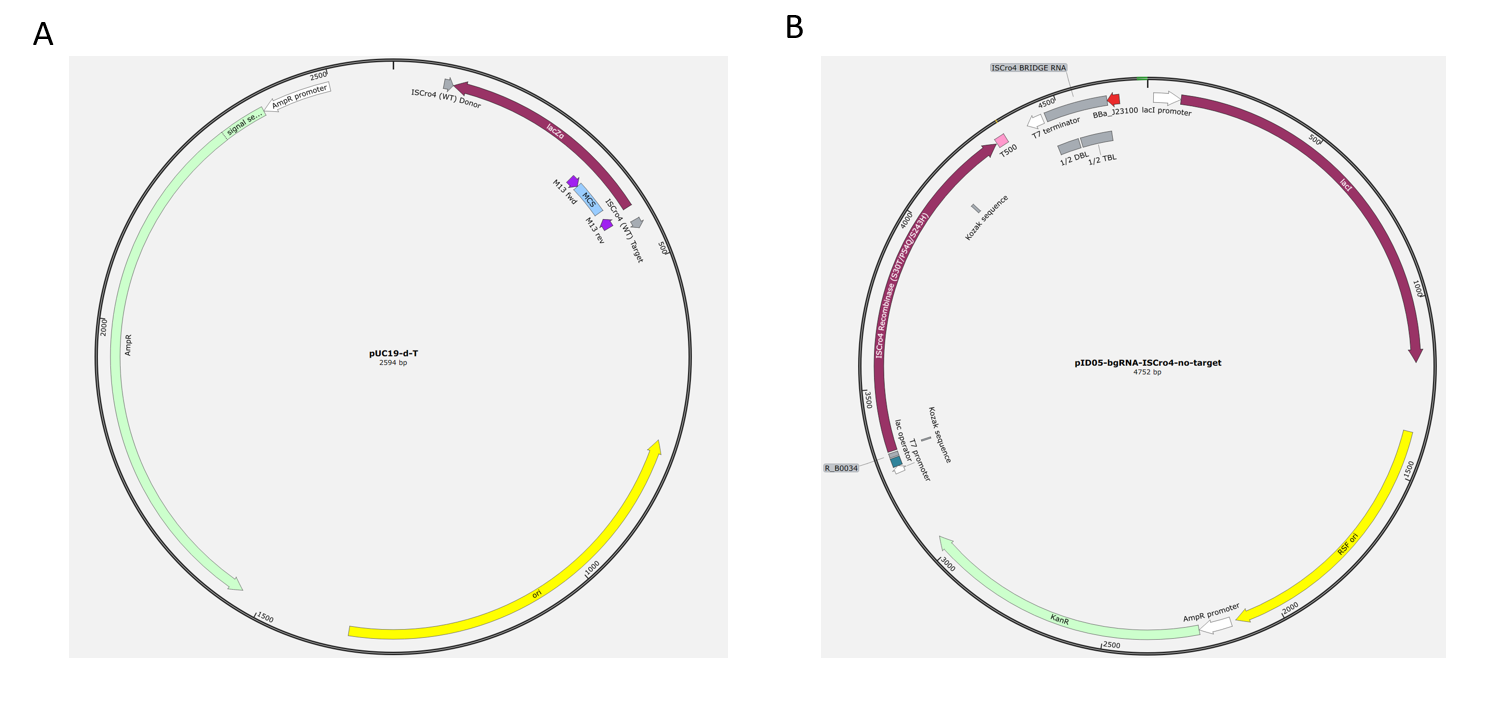
Fig. 5. Revised assay design. (A) pUC19-d-T contains the DNA fragment targeted for deletion, which is located between the (WT) Donor and (WT) Target sequences. (B) pID05 expresses the ISCro4 recombinase. In subsequent experiments, pID05 will serve as the starting construct for protein mutagenesis to identify ISCro4 variants with improved recombination activity.