
AI-agent-assisted research workflow
The AI scientific agent Biomni (Phylo) was used throughout the project as a research assistant. Specifically, Biomni was used for (i) literature exploration and comparison of candidate large-fragment DNA-editing systems during project conception; (ii) diagnosis of the repeated failure to construct the ISCro4 expression plasmid; (iii) interpretation of a published deep-mutational-scanning (DMS) dataset of ISCro4 and nomination of ten candidate mutations, excluding the previously characterized positions S30, P54, and S243; and (iv) design of mutagenesis primers. All agent outputs were treated as hypotheses and independently verified by literature review and experiment before being adopted. Conversations with Biomni were conducted in Chinese; representative exchanges were translated into English for presentation.
Plasmid construction
The previously reported activity-enhanced variant ISCro4(S30T/P54Q/S243H) was used as the parent construct and is referred to as ISCro4 throughout. In the initial two-plasmid design, an expression plasmid carried ISCro4 and its donor site under the strong constitutive J23119 promoter, and a separate functional-validation plasmid carried a chloramphenicol-resistance gene, the guide RNA (gRNA), and the designed target site, such that ISCro4-mediated recombination between the donor and target sites would activate expression of the resistance gene. After repeated failure to obtain the expression plasmid, the design was revised following Biomni-assisted troubleshooting: the promoter driving ISCro4 was replaced with a T7 promoter, and the ISCro4 expression cassette, gRNA, donor site, target site, and resistance marker were consolidated onto a single plasmid, in which a terminator positioned between the WT Donor and WT Target sites is excised upon ISCro4 activity, permitting expression of the downstream chloramphenicol-resistance gene. For the final quantitative assay, the system was split into two plasmids: pUC19-d-T, a pUC19-derived substrate plasmid carrying the DNA fragment targeted for deletion between the WT Donor and WT Target sequences, and pID05, which expresses the ISCro4 recombinase and served as the starting construct for mutagenesis. A control plasmid lacking the ISCro4 expression cassette was generated from the single-plasmid design. All constructs were verified by Sanger sequencing. Plasmids were constructed by Gibson and propagated in E. coli DH5α.
Chloramphenicol susceptibility assay
To assess basal antibiotic tolerance in the absence of ISCro4 activity, E. coli cells carrying the control plasmid lacking the ISCro4 expression cassette were grown on LB agar plates containing 0, 25, or 100 μg/ml chloramphenicol, and growth was assessed after incubation at 37℃, 220 rpm.
DMS-guided mutation selection and site-directed mutagenesis
Ten candidate mutations were nominated from a published ISCro4 DMS dataset with Biomni's assistance, excluding positions S30, P54, and S243 already present in the parent construct. The catalytically inactivating mutation E60Q, previously reported to abolish ISCro4 DNA cleavage activity, was included as a negative control. Mutagenesis primers were designed with Biomni's assistance (Table S1). Mutations were introduced into pID05 by [mutagenesis method, e.g., inverse PCR followed by DpnI digestion], and all mutant plasmids were verified by Sanger sequencing.

Table.S1 Primers designed for site-directed mutagenesis of ten DMS-selected ISCro4 variants.
The table lists amino acid substitutions and positions, original and substituted codons, and forward and reverse primer sequences (5′–3′). Primer lengths (nt), GC contents (%), predicted melting temperatures (Tm, °C) of the forward primer 3′ annealing regions and reverse primers, and overlap lengths (bp) and predicted Tm values are provided. DMS, deep mutational scanning.
qPCR-based DNA deletion assay
After constructing the plasmids and co-transforming them with pUC19-d-T into E. coli, we used qPCR to quantify the DNA deletion efficiency. As illustrated in Fig. 1, we designed two sets of qPCR primers for this purpose. The primer pair shown in Fig. 1B was used to quantify the relative abundance of the plasmid backbone, whereas the two primers shown in Fig. 1A were positioned on the plasmid backbone and within the region targeted for deletion by ISCro4, respectively. By comparing the qPCR signals obtained from these primer sets, we were able to determine the extent of DNA deletion and thereby evaluate the activity of ISCro4.
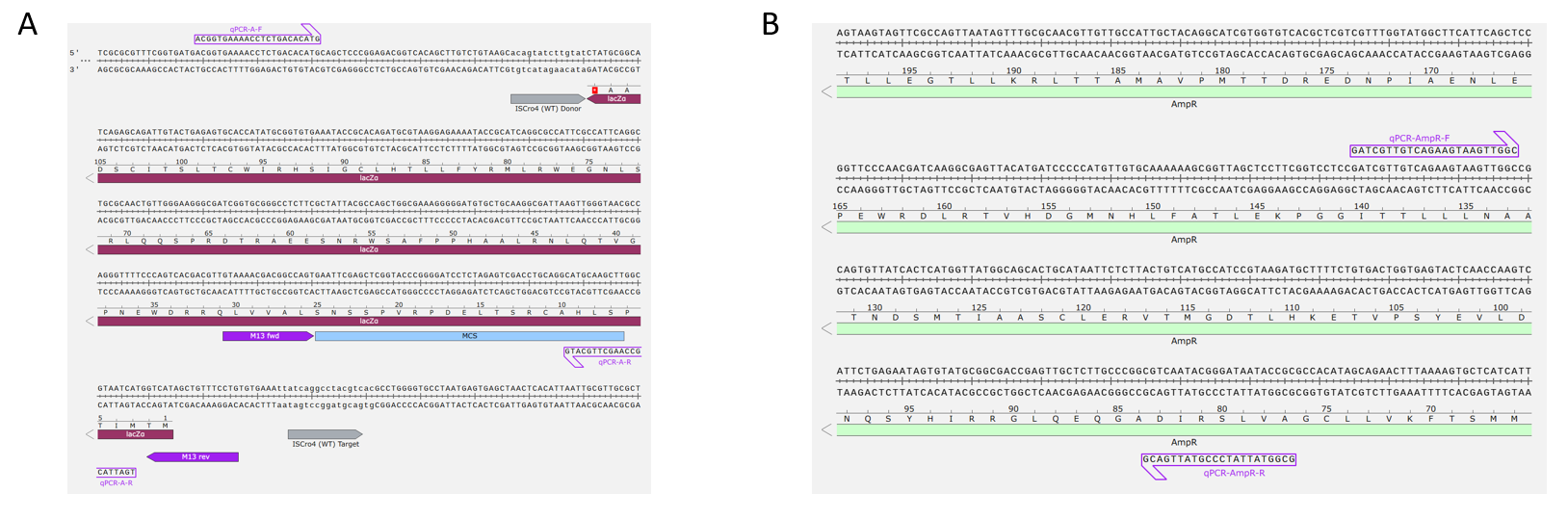
Fig. 1. qPCR primers.
Each pID05 variant was co-transformed with pUC19-d-T into E. coli DH5α, and ISCro4 expression was induced with [IPTG concentration, temperature, duration]. For each variant, three independent colonies were randomly selected and cultured overnight; cultures were diluted to normalize OD600 before analysis, and two technical replicates were performed per sample. Two qPCR primer pairs were used (Fig. 1): qPCR-A-F/-R, with one primer on the plasmid backbone and the other within the region targeted for deletion, and qPCR-AmpR-F/-R, which quantifies the plasmid backbone as a normalization reference. qPCR was performed using [master mix] on [instrument] with the following cycling conditions: [program]; template was prepared by [e.g., boiled colony lysate]. DNA deletion efficiency was relatively quantified as ΔCq = Cq(qPCR-A) − Cq(qPCR-AmpR); a larger ΔCq indicates a greater extent of ISCro4-mediated deletion. Variants with ΔCq exceeding that of the parent ISCro4 control were considered positive hits.