
Directed Evolution
of ISCro4
Biomni-assisted, DMS-guided directed evolution in E. coli
 bridge RNA-guided recombination
- Directed evolution
- AI scientific agent
- ISCro4
- Genome editing
- RNA-guided recombination

Editing small changes is no longer the hardest part
Our interest in large-fragment DNA editing led us to ISCro4.
With Biomni’s guidance and our own literature review, we compared emerging DNA-editing systems and chose ISCro4 for directed evolution. The project tested whether its recombination activity could be further improved in E. coli.
Research interest → Literature review → Experimental validation

Nucleotide-scale precision
TT
AG
CC
GA
TG
C
Excellent for small changes
Gene-sized DNA cargo
Precise insertion remains difficult
From published data to experiment
Published DMS
Deep mutational scan
E. coli
DNA deletion assay
Engineered parent
Can additional single mutations improve activity?
Can an AI agent help a student team test them?
The Challenge
Our starting construct was the previously reported ISCro4(S30T/P54Q/S243H) variant, not wild-type ISCro4.
Biomni helped us troubleshoot plasmid construction, select ten DMS-nominated mutations, and design primers. Its suggestions were checked through literature review and experiments.

So we asked:
Can we improve ISCro4 recombination activity, and can an AI scientific agent help a high school team complete directed evolution?
Meet ISCro4
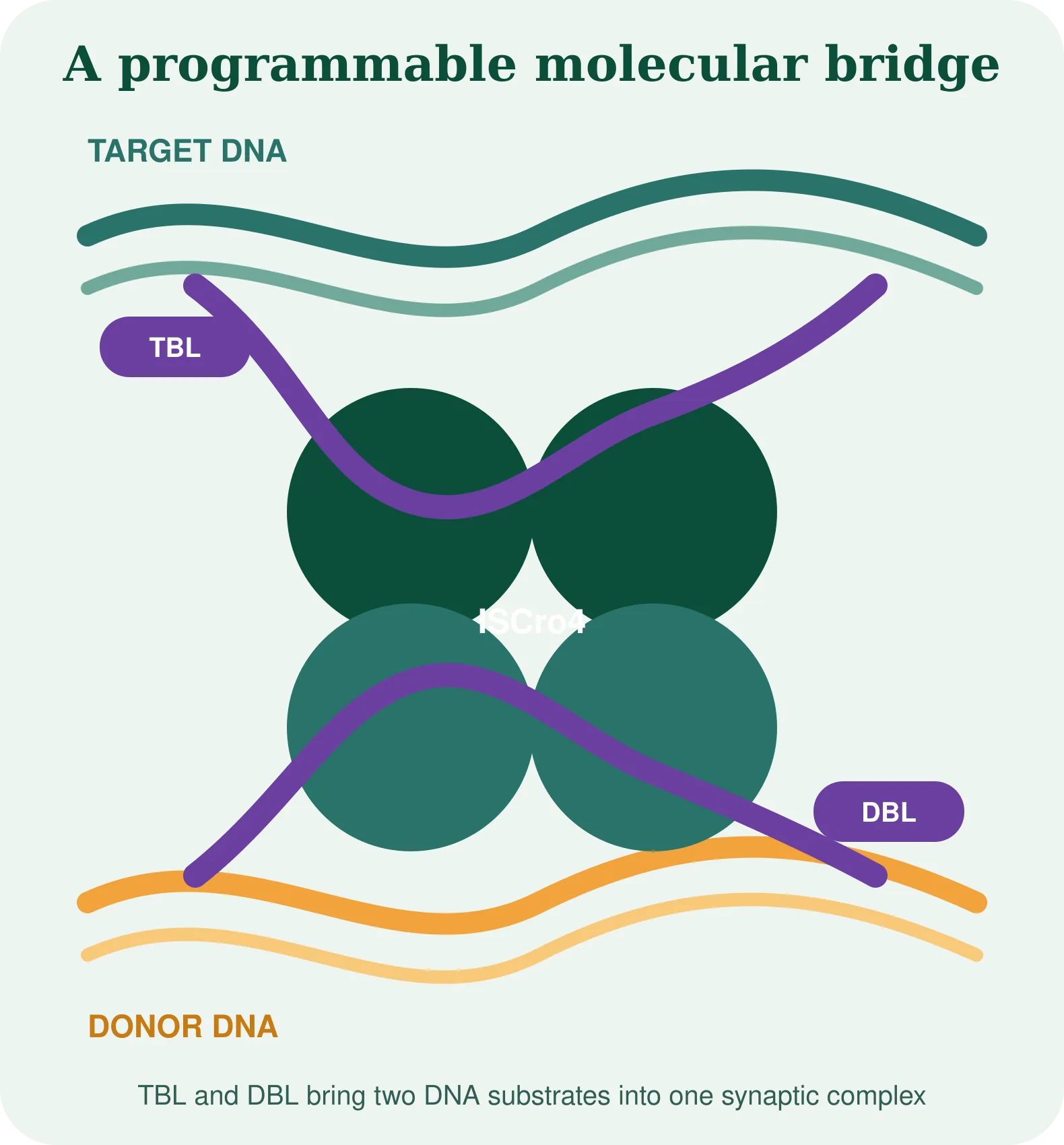
ISCro4 is a compact, RNA-guided bridge recombinase.
Its bridge RNA uses two programmable modules:
TBL recognizes target DNA; DBL recognizes donor DNA.
Together they assemble both DNA substrates for direct recombination without relying on HDR.
Our measured outcome: plasmid-borne DNA deletion in E. coli, not genomic integration or inversion.
From an Engineered Parent to A225S
BASELINE → DMS CANDIDATES → qPCR → A225S
Starting point: ISCro4(S30T/P54Q/S243H).
Protein engineering
Screen ten DMS-nominated single mutations, excluding the three positions already changed in the parent.
Assay development
Replace leaky chloramphenicol selection with a quantitative qPCR-based DNA deletion assay.
Outcome: A225S showed a larger ΔCq than the engineered parent; one positive hit among ten candidates.

Protein engineering and assay development
Protein engineering
DMS-guided substitutions
Single-mutant screening
Ten candidate mutations
Assay development
Leaky antibiotic selection
Two-plasmid deletion assay
Parent and E60Q controls
A225S: improved activity relative to the engineered parent
Let’s Explore
ISCro4 Evolution!

Core Question
Can mutation stacking and accessory proteins jointly improve ISCro4/MM168 inversion activity in E. coli?
From hypothesis to evidence
Starting construct
Select mutations
Measure activity
Improved over parent
What the results establish
A225S improved plasmid-borne DNA deletion activity in E. coli. Genomic integration, maximum payload size, editing fidelity and mammalian-cell activity remain to be tested.
Only single mutations were evaluated; combining mutations and structural modeling are future work.