

Y87Q: Making Reaction-Ready States Easier to Reach
In PET-film assays with purified enzymes, Y87Q released about 1.9-fold more soluble hydrolysis products than FAST-PETase at 60 °C. At 70 °C, the increase was about 4.9-fold. Residue 87 lies outside the catalytic triad. A direct strengthening of a catalytic interaction was therefore not a sufficient explanation. MD showed that the overall protein fold was largely retained. The local second-shell environment around the catalytic region, however, was reorganized.
The substitution introduced a persistent local interaction between Gln87 and Met161. Although small in a static structure, the difference changed the conformations sampled by the bound enzyme–substrate system. We wanted to know whether the substrate repeatedly reached an arrangement suitable for attack by catalytic Ser160. This moved our analysis from whether PET could bind to what happened after it was bound. A single favorable pose would show a possible attack geometry, but it could not show how often that geometry occurred. For that, we needed to examine the distribution of structures over time.
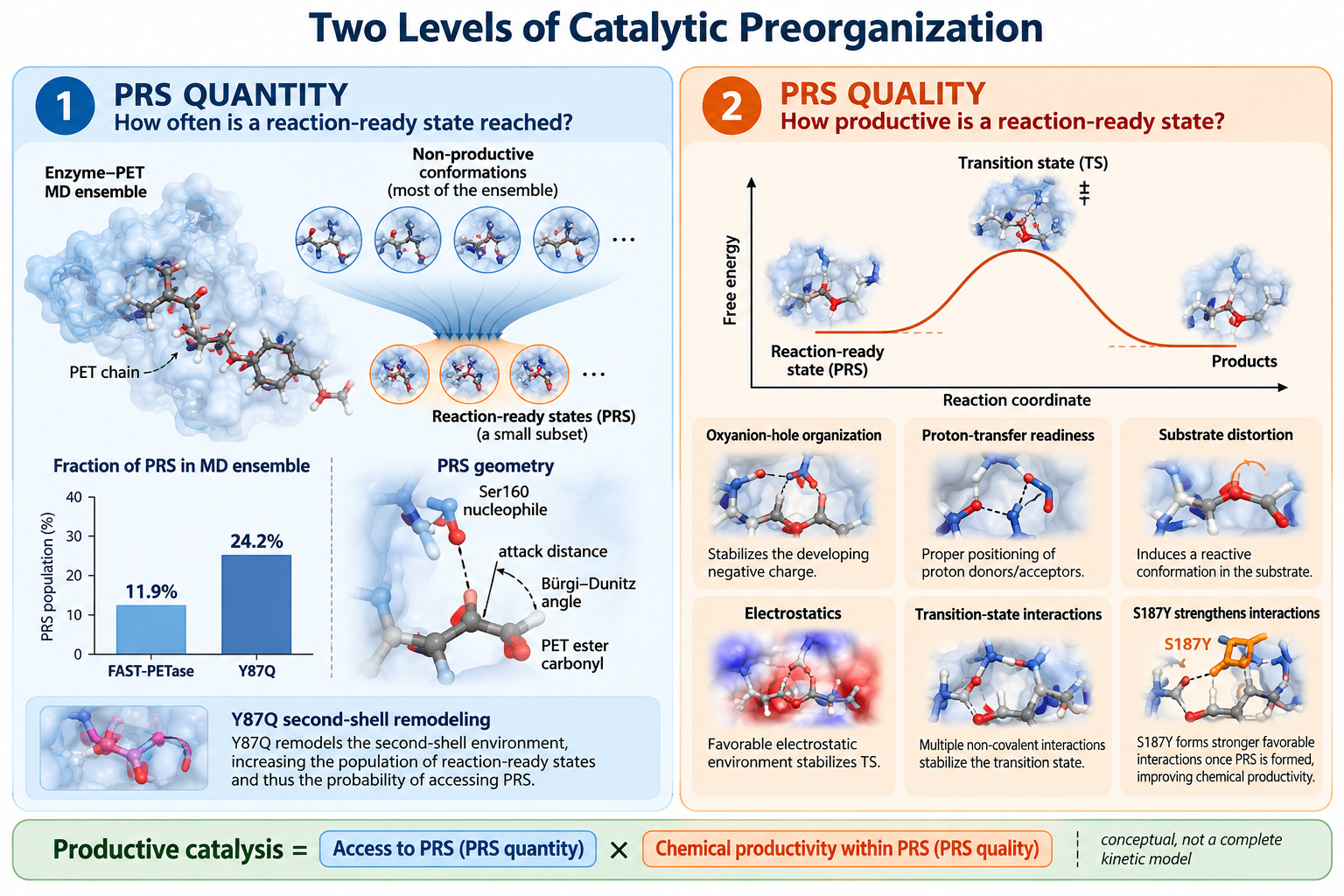
We defined a geometric PRS using two features. The first was the distance between the Ser160 nucleophile and the PET-derived ester carbonyl. The second was the Bürgi–Dunitz approach angle. For FAST-PETase, 11.9 ± 1.4% of sampled configurations met these criteria. For Y87Q, the proportion was 24.2 ± 2.8%. The surrounding catalytic environment was also better engaged within the reaction-ready configurations.
We interpret these observations as a change in how often existing states are sampled. Y87Q allows the enzyme–substrate system to spend more time in arrangements from which chemistry could begin, without requiring a new catalytic mechanism. Part of the gain can therefore be explained by improved access to reaction-ready structures.
We also examined reaction energy using quantum-chemical calculations on representative structures taken from PRS configurations. The mean calculated acylation barrier decreased from 20.1 kcal mol⁻¹ for FAST-PETase to 18.6 kcal mol⁻¹ for Y87Q. Distortion/interaction analysis associated much of the improvement with a smaller structural distortion requirement. Before the chemical step began, the system was already closer to the arrangement needed for reaction. PRS quantity is the term we use for the population and accessibility of these geometrically reaction-ready states.
S187Y: When Better Binding Does Not Explain Better Catalysis
The candidates in our second route behaved differently. We modeled mutations near the substrate-binding region and used docking to decide which to test. S187Y produced the largest improvement in PET-film hydrolysis among the substitutions tested in this route.
The activity ranking from experiments differed from the docking-energy ranking. Several mutations with favorable docking scores produced little or no activity gain, whereas S187Y increased PET-film hydrolysis by about 2.18-fold in its FAST-PETase-derived background. We also tested the substitution in the independently engineered ThermoStable-PETase scaffold. It showed an improvement of about 3.44-fold, with increased formation of both MHET and TPA.
The binding score helped us determine whether a favorable bound configuration could form. In order to help understand the activity observed in our experiment, we had to gain insight into how the system proceeds from the binding state towards a transition state and completes the chemical reaction. A favorable binding state by itself does not provide us with information about how easy that is going to be. It is appropriate to use docking to study the binding state, but the chemical reactions need different analysis techniques. If there is a mismatch between the ranking of the experimental activities and the binding score, we must investigate further.
The quantum-chemical results supported this interpretation. The overall serine-hydrolase reaction topology was retained in FAST-PETase, Y87Q, and S187Y, but their mean calculated acylation barriers were 20.1, 18.6, and 17.8 kcal mol⁻¹, respectively. DIAS analysis suggested that the main advantage of S187Y differed from that of Y87Q. Reduced distortion was the principal association for Y87Q, whereas favorable interactions in the transition-state region contributed more strongly for S187Y. This is consistent with an improvement in PRS quality. A more direct quantitative assignment will still require future analyses conditioned on PRS configurations.
PRS Quantity and PRS Quality: Two Levels of Catalytic Preorganization
Comparing Y87Q with S187Y led us to distinguish two complementary aspects of catalytic preorganization. Catalysis requires a reaction-ready geometry, but meeting the geometric criteria alone is insufficient. Two enzyme–substrate configurations with the same nucleophile–electrophile distance and attack angle may still differ substantially in oxyanion hole organization, proton-transfer readiness, electrostatic complementarity, substrate distortion, hydration, and transition-state stabilization. The opposite limitation is also possible: an enzyme may reach highly productive reaction-ready configurations so rarely that the overall catalytic flux remains restricted by their low population.
In this description, PRS quantity is the probability of the conformational ensemble entering a geometrically competent, reaction-ready subensemble. PRS quality refers to the chemical productivity of configurations in that subensemble. Y87Q mostly demonstrates the quantity factor since the modification of the second shell provides attack-friendly conformations and decreases the distortion required to reach the transition state region. On the other hand, S187Y presents an example of the complementary factor where catalysis is enhanced with favorable contacts after a reaction-ready enzyme–substrate configuration has formed. The distinction separates two questions that an activity measurement often combines: can the enzyme reach a catalytically competent configuration, and how productive is the configuration once reached? This framework is not a complete kinetic model of PET depolymerization. Nor are PRS quantity and PRS quality independent rate constants. We use them as mechanistic descriptors to distinguish access to catalytic states from chemical productivity within those states. This is also how the original analysis treats them: as complementary quantities that cannot be used interchangeably, within a conceptual model rather than a complete kinetic account of the degradation process.
References
- Wei, R.; von Haugwitz, G.; Pfaff, L.; Mican, J.; Badenhorst, C.P.S.; Liu, W.; Weber, G.; Austin, H.P.; Bednar, D.; Damborsky, J.; et al. Mechanism-based design of efficient PET hydrolases. ACS Catal. 2022, 12, 3382–3396. https://doi.org/10.1021/acscatal.1c05856
- Han, X.; Liu, W.; Huang, J.-W.; Ma, J.; Zheng, Y.; Ko, T.-P.; Xu, L.; Cheng, Y.-S.; Chen, C.-C.; Guo, R.-T. Structural insight into catalytic mechanism of PET hydrolase. Nat. Commun. 2017, 8, 2106. https://doi.org/10.1038/s41467-017-02255-z
- Jerves, C.; Neves, R.P.P.; Ramos, M.J.; da Silva, S.; Fernandes, P.A. Reaction mechanism of the PET degrading enzyme PETase studied with DFT/MM molecular dynamics simulations. ACS Catal. 2021, 11, 11626–11638. https://doi.org/10.1021/acscatal.1c03700
- Luo, S.; Liu, L.; Lyu, C.-J.; Sim, B.; Liu, Y.; Gong, H.; Nie, Y.; Zhao, Y.-L. Understanding the effectiveness of enzyme pre-reaction state by a quantum-based machine learning model. Cell Rep. Phys. Sci. 2022, 3, 101128. https://doi.org/10.1016/j.xcrp.2022.101128
- Jerves, C.; Neves, R.P.P.; da Silva, S.L.; Ramos, M.J.; Fernandes, P.A. Rate-enhancing PETase mutations determined through DFT/MM molecular dynamics simulations. New J. Chem. 2024, 48, 45–54. https://doi.org/10.1039/D3NJ04204A
- Li, C.; Wei, D.-Q.; Miao, W.; Li, J. Molecular origin of the enhanced PET degradation activity of LCC-ICCG revealed by computational modeling. Catalysts 2026, 16, 730. https://doi.org/10.3390/catal16080730
- Guimarães, C.R.W.; Repasky, M.P.; Chandrasekhar, J.; Tirado-Rives, J.; Jorgensen, W.L. Contributions of conformational compression and preferential transition state stabilization to the rate enhancement by chorismate mutase. J. Am. Chem. Soc. 2003, 125, 6892–6899. https://doi.org/10.1021/ja021424r
- Jiang, Y.; Ding, N.; Shao, Q.; Stull, S.L.; Cheng, Z.; Yang, Z.J. Substrate positioning dynamics involves a non-electrostatic component to mediate catalysis. J. Phys. Chem. Lett. 2023, 14, 11480–11489. https://doi.org/10.1021/acs.jpclett.3c02444
- Sadiq, S.K.; Coveney, P.V. Computing the role of near attack conformations in an enzyme-catalyzed nucleophilic bimolecular reaction. J. Chem. Theory Comput. 2015, 11, 316–324. https://doi.org/10.1021/ct5008845
- Li, A.; Song, Y.; Hu, J.; Zhang, H.; Li, Z.; Tang, J.; Huang, H.; Li, S.; Li, X. Integrating graph learning and meta-learning to enhance PET hydrolase activity at elevated temperatures. Cell Rep. Phys. Sci. 2026, 7, 103037. https://doi.org/10.1016/j.xcrp.2025.103037
- Zheng, Y.; Li, Q.; Liu, P.; Yuan, Y.; Dian, L.; Wang, Q.; Liang, Q.; Su, T.; Qi, Q. Dynamic docking-assisted engineering of hydrolases for efficient PET depolymerization. ACS Catal. 2024, 14, 3627–3639. https://doi.org/10.1021/acscatal.4c00400
- Burgin, T.; Pollard, B.C.; Knott, B.C.; Mayes, H.B.; Crowley, M.F.; McGeehan, J.E.; Beckham, G.T.; Woodcock, H.L. The reaction mechanism of the Ideonella sakaiensis PETase enzyme. Commun. Chem. 2024, 7, 65. https://doi.org/10.1038/s42004-024-01154-x
- Bürgi, H. B.; Dunitz, J. D.; Lehn, J. M.; Wipff, G. Stereochemistry of Reaction Paths at Carbonyl Centres. Tetrahedron 1974, 30, 1563–1572. https://doi.org/10.1016/S0040-4020(01)90678-7
- Zholdassov, Y.S.; Yuan, L.; Garcia, S.R.; Kwok, R.W.; Boscoboinik, A.; Valles, D.J.; Marianski, M.; Martini, A.; Carpick, R.W.; Braunschweig, A.B. Acceleration of Diels–Alder reactions by mechanical distortion. Science 2023, 380, 1053–1058. https://doi.org/10.1126/science.adf5273
- Bickelhaupt, F.M.; Houk, K.N. Analyzing reaction rates with the distortion/interaction–activation strain model. Angew. Chem. Int. Ed. 2017, 56, 10070–10086. https://doi.org/10.1002/anie.201701486
- Sengupta, A.; Li, B.; Svatunek, D.; Liu, F.; Houk, K.N. Cycloaddition reactivities analyzed by energy decomposition analyses and the frontier molecular orbital model. Acc. Chem. Res. 2022, 55, 2467–2479. https://doi.org/10.1021/acs.accounts.2c00343
- García-Meseguer, R.; Ortí, E.; Tuñón, I.; Ruiz-Pernía, J.J.; Aragó, J. Insights into the enhancement of the poly(ethylene terephthalate) degradation by FAST-PETase from computational modeling. J. Am. Chem. Soc. 2023, 145, 19243–19255. https://doi.org/10.1021/jacs.3c04427