

Experimental Ground Truth and Mechanistic Diagnosis
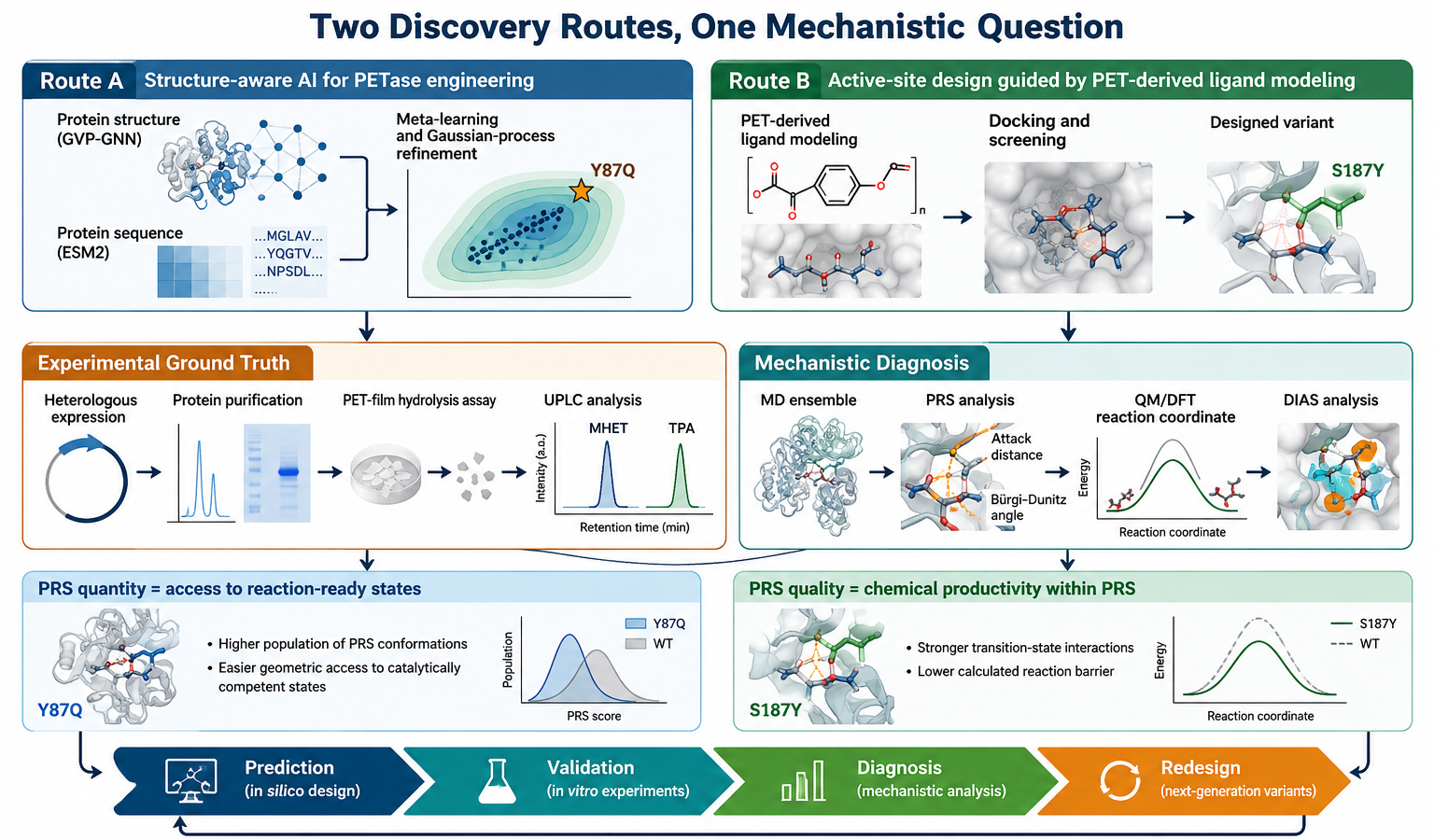
Candidates from both routes were assessed using the same experimental protocol. After expressing and purifying the enzymes, we tested them in controlled PET-film hydrolysis assays and used UPLC to quantify soluble MHET and TPA. These measurements established whether the selected variants improved PET hydrolysis, independently of their computational scores. The observed performance then became the basis for our mechanistic analysis.
We then examined the validated variants with MD, PRS analysis, quantum chemistry, and DIAS. Having used design methods to select candidates and experiments to establish performance, we used these models to ask why a mutation worked. Both discovery routes led to this investigation of the catalytic limitation affected by a useful substitution.
Experimental Validation, Scope, and Limitations
Why Experimental Validation Still Matters
With improvements in the accuracy of computational enzyme design, experiments become more focused rather than dispensable. Protein expression and purification establish whether the attractive computational candidate sequence will be produced into an actual enzyme. The PET-film assay checks whether the molecular hypothesis remains true within the framework of a heterogeneous substrate, whereas the quantification of MHET and TPA by UPLC assures that the phenotype is indeed the result of PET hydrolysis, rather than the indirect outcome of some kind of experimental process. Finally, cross-scaffold testing of the effect of the mutation (in the case of S187Y) verifies whether the beneficial effect will be transferable to other protein scaffolds.
The reason is that experimental activity remains the only source of ground truth in our protocol. Computational modeling provides candidates for experimentation, whereas mechanistic simulation explains the selected mechanisms. Neither one takes place of the experimental proof of enzyme behavior on PET substrates. This division is particularly important in the case of heterogeneous, interfacial reaction, where the microscopic catalytic properties and macroscopic substrate access are closely interlinked.
What Our Computational Models Can—and Cannot—Tell Us
The same criterion also sets bounds to the application of our mechanistic interpretation. The decomposition of PET requires an appropriate polymer morphology, accessible surfaces, chain flexibility, binding and adsorption of enzymes, product removal, and chemical turnover. Thus, the molecular simulations we perform starting with bound PET substrates investigate only one part of the whole degradation process. PRS distributions and quantum-chemical activation energy barriers must hence be treated as mechanistic descriptors, not quantitative predictors of the degradation rate of PET films.
This idea lies at the heart of the approach. A microscopic descriptor is valuable not because of its numerical equivalence to the macroscopic activity, but because it demonstrates a physically meaningful difference between the variants and provides the hypothesis for the next iteration of design cycle. In other words, the limitations of a model make the scale at which its conclusions become relevant. In our approach, experiments prove the change in performance, while simulations identify the change in a certain part of the catalytic mechanism.
A Modular Workflow Connecting Prediction, Experiment, and Mechanism
One important aspect of this project is the combination of computational search and mechanistic analysis in a modular workflow. Rather than utilizing one computational approach to predict the activity of enzymes, we are applying multiple approaches to different tasks and stages in the research process.
In the discovery phase, computational approaches are used to traverse sequence space and select candidates that are feasible to be tested experimentally. There are two pathways here: one pathway is the combination of graph-based structure learning and sequence modeling guided by experimental results, while the other pathway concerns active-site optimization and docking. After obtaining variants from computational prediction, we performed protein expression, purification, PET-film hydrolysis assays, and UPLC analysis to determine whether these variants improved PET degradation activity.We will go on to the mechanistic analysis only after validating experimentally, where molecular dynamics simulation, pre-reaction state analysis, quantum chemistry calculation, and DIAS are included. This way, the two computational discovery pathways are brought together through experimental validation and subsequent mechanistic analysis.
It is significant that such roles are kept separate since sequence prediction, docking, molecular dynamics, and quantum chemistry all refer to different facets of enzyme action. For instance, while docking assesses the feasibility of a specific complex, molecular dynamics describes the distribution of conformations sampled over time.Then, pre-reaction state analysis seeks whether appropriate geometries of the complex exist in this conformational ensemble, and quantum chemistry assesses the energy cost of a chemical reaction for the chosen conformations. Thus, by maintaining such distinctions, the pipeline can be adjusted to another enzyme family without having to replace experimental activity with a computational quantity.
Experimental Activity as Ground Truth, Not Just a Final Score
Another crucial characteristic of the current workflow is that computational predictions of mutations are validated through experimental testing. Mutations identified computationally as potentially successful are deemed to have reached their goal when they are verified experimentally as active. Protein expression and purification provide the first evidence that a designed variant can be expressed and isolated in the form of an active enzyme, whereas PET-film degradation is a proof of functionality in the context of the heterogeneous polymer substrate. UPLC measurements of MHET and TPA provide further evidence that the observed activity corresponds to the breakdown of PET.
Experimental activity, however, plays an important role not only as the ultimate ranking criterion for the mutations but also because it is the result that needs to be explained by simulations. S187Y is a very illustrative case here. Although some variants had favorable docking scores, they did not necessarily show higher activity, whereas S187Y substantially improved PET hydrolysis.We did not take this discrepancy as the weakness of computations but used it to define the boundaries of binding-oriented approach.
The experimental function makes the process necessarily iterative. Computer models formulate the hypotheses that are then tested by experiments, the mechanistic analysis explains what makes certain versions work and others fail, and that informs the design for the next iteration.

References
- Jurich, C.; Shao, Q.; Ran, X.; Yang, Z.J. Physics-based modeling in the new era of enzyme engineering. Nat. Comput. Sci. 2025, 5, 279–291. https://doi.org/10.1038/s43588-025-00788-8
- Luo, S.; Liu, L.; Lyu, C.-J.; Sim, B.; Liu, Y.; Gong, H.; Nie, Y.; Zhao, Y.-L. Understanding the effectiveness of enzyme pre-reaction state by a quantum-based machine learning model. Cell Rep. Phys. Sci. 2022, 3, 101128. https://doi.org/10.1016/j.xcrp.2022.101128
- Wu, L.; Qin, L.; Nie, Y.; Xu, Y.; Zhao, Y.-L. Computer-aided understanding and engineering of enzymatic selectivity. Biotechnol. Adv. 2022, 54, 107793. https://doi.org/10.1016/j.biotechadv.2021.107793
- Sadiq, S.K.; Coveney, P.V. Computing the role of near attack conformations in an enzyme-catalyzed nucleophilic bimolecular reaction. J. Chem. Theory Comput. 2015, 11, 316–324. https://doi.org/10.1021/ct5008845
- Li, A.; Song, Y.; Hu, J.; Zhang, H.; Li, Z.; Tang, J.; Huang, H.; Li, S.; Li, X. Integrating graph learning and meta-learning to enhance PET hydrolase activity at elevated temperatures. Cell Rep. Phys. Sci. 2026, 7, 103037. https://doi.org/10.1016/j.xcrp.2025.103037
- Zheng, Y.; Li, Q.; Liu, P.; Yuan, Y.; Dian, L.; Wang, Q.; Liang, Q.; Su, T.; Qi, Q. Dynamic docking-assisted engineering of hydrolases for efficient PET depolymerization. ACS Catal. 2024, 14, 3627–3639. https://doi.org/10.1021/acscatal.4c00400
- Burgin, T.; Pollard, B.C.; Knott, B.C.; Mayes, H.B.; Crowley, M.F.; McGeehan, J.E.; Beckham, G.T.; Woodcock, H.L. The reaction mechanism of the Ideonella sakaiensis PETase enzyme. Commun. Chem. 2024, 7, 65. https://doi.org/10.1038/s42004-024-01154-x
- Bürgi, H. B.; Dunitz, J. D.; Lehn, J. M.; Wipff, G. Stereochemistry of Reaction Paths at Carbonyl Centres. Tetrahedron 1974, 30, 1563–1572. https://doi.org/10.1016/S0040-4020(01)90678-7
- Wei, R.; Westh, P.; Weber, G.; Blank, L.M.; Bornscheuer, U.T. Standardization guidelines and future trends for PET hydrolase research. Nat. Commun. 2025, 16, 4684. https://doi.org/10.1038/s41467-025-60016-9
- Knott, B.C.; Erickson, E.; Allen, M.D.; Gado, J.E.; Graham, R.; Kearns, F.L.; Pardo, I.; Topuzlu, E.; Anderson, J.J.; Austin, H.P.; et al. Characterization and engineering of a two-enzyme system for plastics depolymerization. Proc. Natl. Acad. Sci. USA 2020, 117, 25476–25485. https://doi.org/10.1073/pnas.2006753117
- Bickelhaupt, F.M.; Houk, K.N. Analyzing reaction rates with the distortion/interaction–activation strain model. Angew. Chem. Int. Ed. 2017, 56, 10070–10086. https://doi.org/10.1002/anie.201701486
- Sengupta, A.; Li, B.; Svatunek, D.; Liu, F.; Houk, K.N. Cycloaddition reactivities analyzed by energy decomposition analyses and the frontier molecular orbital model. Acc. Chem. Res. 2022, 55, 2467–2479. https://doi.org/10.1021/acs.accounts.2c00343