

Project Overview
Improvement in the activity and heat stability of PET hydrolases was made possible through rational design, directed evolution, machine learning and structure-based design. As for our project, we are going to explore why a particular beneficial mutation leads to the observed improvement. Mutation may affect substrate binding, motion of the protein, catalytic geometry and local electrostatics. Transition state may be stabilized by the mutation, and more than one of the above processes can occur at a time. While activity data can tell us if a particular variant works better, it does not provide answers to why it does so.
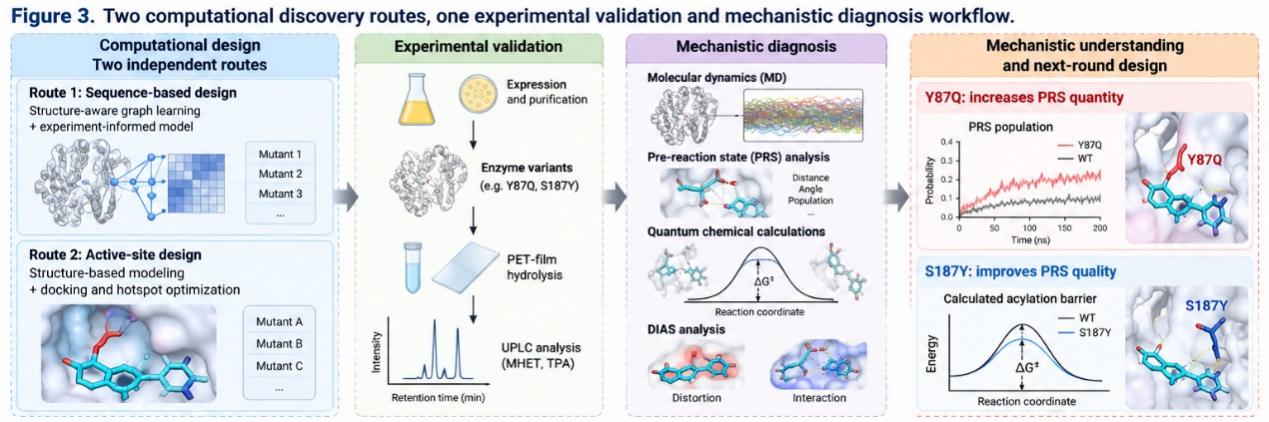
Our project is based on the above question, and uses structure aware AI and active site design in order to find potential candidates. two routes led to experimentally validated variants Y87Q and S187Y, which showed improved activity. Then molecular dynamics (MD), pre-reaction state (PRS) analysis, quantum chemistry, distortion/interaction activation-strain (DIAS) analysis were used to study the effects of these mutations and the factors limiting PET hydrolysis.
Based on our results, we looked at catalytic preorganization based on two parameters: PRS quantity and PRS quality. The first is the frequency with which the enzyme-substrate system gets into a conformation allowing the beginning of a reaction. The second is the extent to which this conformation provides conditions for carrying out the chemical reaction. We now have a strategy to follow in our design once we find a mutation that increases activity – to look for the limiting step.
Our Vision: Designing the Bottleneck, Not Just the Mutation
The history of engineering the PET hydrolases has clearly demonstrated that enhanced enzymes can be generated through rational design, directed evolution, machine learning, protein language models, or through their combination. Nevertheless, the development in molecular simulations and computational enzyme design makes it possible to study increasingly detailed properties such as conformational preorganization, substrate positioning, transition-state interaction, electric fields, and dynamic ensembles. Consequently, the next step should not only include further enhancement of each of the approaches mentioned above but also the integration of prediction, experimentation, and physical interpretation.
Indeed, different computational approaches are best suited for different tasks. Protein language models can provide insights into promising regions of sequence space, while generative models can suggest novel sequences or scaffolds. Molecular simulations can clarify the dynamical behavior of the structures, while quantum chemistry can help to investigate chemical states that cannot be effectively predicted using solely static structure prediction approach. Experimental work will determine whether the overall molecular hypothesis works in reality. In our case, the catalytic bottleneck is the core of the hierarchical approach.
From this point of view, Y87Q and S187Y are not merely two more PET hydrolase variants with increased activity. Rather, they are two different solutions to a common catalytic challenge. While Y87Q seems primarily to modulate the ease with which the enzyme adopts reaction-compatible conformations, S187Y fits the pattern of creating an improved.
From Better Mutants to a Reusable Engineering Framework
The importance of this work extends beyond the identification of PET hydrolase variants with enhanced activity. Our goal here is to demonstrate that enzyme engineering should go beyond the question of which mutation is effective and start considering why it is effective and what should be improved next. To this purpose, we designed a workflow, involving both computational and experimental techniques, to be applied in an iterative manner.
Enzyme engineering of PET hydrolases takes into account the features at various levels. Activity observed experimentally might be associated not only with the intrinsic chemical activity of the enzyme but also with the accessibility of the substrate, binding mode, flexibility of the protein, geometry of the catalysis, electrostatics, and stabilization of the transition state. That is why catalytic activity cannot be quantified with just one computational score. In our work, we did not combine various methods into one universal ranking function. On the contrary, each computational and experimental method served the purpose of answering a particular mechanistic question.
Using two independent design routes, we identified the PET hydrolase variants Y87Q and S187Y and validated their improved activity experimentally. To understand how these mutations affect different stages of the catalytic process, we performed molecular dynamics simulations, pre-reaction-state analysis, quantum-chemical calculations, and distortion/interaction activation-strain analysis. Based on these findings, we propose two general conclusions: PRS quantity and PRS quality should be considered separately, and enzyme engineering can benefit from a Design-Build-Test-Diagnose-Learn-Redesign workflow.
PRS Quantity and PRS Quality: Two Levels of Catalytic Preorganization
The critical mechanistic insight gained through this project is the separation of PRS quantity from PRS quality.
Not all geometries sampled by the enzyme-substrate complex catalyze reactions. Prior to a catalytic step taking place, the reacting groups must first attain the proper relative positioning. We call such geometries, which allow for chemical reactions to happen, pre-reaction states (PRS). Molecular dynamics enables us to consider PRSs not in terms of an optimally structured geometry, but as a subset of the conformational space.
We define PRS quantity as the probability of the enzyme-substrate ensemble finding itself in a reaction-ready subensemble. One clear case where we observed this in our study was Y87Q. Using the nucleophile-carbonyl distance in Ser160 and the Burgi-Dunitz attack geometry as criteria for a PRS, we found that PRS quantity in Y87Q increases from 11.9 +/- 1.4% in FAST-PETase to 24.2 +/- 2.8%. Thus, the mutation does not just change how a static structure looks; it also changes the probability with which it samples reaction-ready geometries.
Nevertheless, a catalytically active geometry does not always correspond to efficient chemistry. It is possible that two geometries can be characterized by identical distance and angle criteria and yet differ in the parameters directly related to catalysis, such as oxyanion hole arrangement, ability to perform proton transfers, electrostatics, substrate strain, hydration, and transition-state interactions. In this regard, we introduce the term PRS quality to characterize the chemical efficiency of reaction-ready geometries.
The variant S187Y provides an example of why this distinction is important. Its activity was not predicted by the docking-energy ranking. However, experimentally it increased PET-film hydrolysis, and quantum-chemical calculations showed a lower mean acylation barrier. DIAS analysis suggested that the advantage of S187Y was associated more strongly with favorable transition-state interactions than with the reduced distortion observed for Y87Q. Therefore, S187Y is consistent with improved chemical quality of reaction-ready configurations, although a more direct quantitative evaluation will require further PRS-conditioned analysis.
The more general insight gained from this study is thus the distinction between access to catalytically active states versus chemical efficiency of such states. Both factors are complementary but not equivalent. In this way, the approach should be seen as a mechanistic diagnostic method rather than an exhaustive kinetic analysis of PET depolymerization by PET hydrolases.
It might be also helpful for the analysis of other enzymes where the catalytic process is highly dependent on substrate orientation and dynamics. For such enzymes, the next steps in future research would involve asking two consecutive questions: (1) whether reaction-ready states are formed frequently enough, and (2) whether such states are chemically efficient.
References
- Buller, R.; Lutz, S.; Kazlauskas, R.J.; Snajdrova, R.; Moore, J.C.; Bornscheuer, U.T. From nature to industry: Harnessing enzymes for biocatalysis. Science 2023, 382, eadh8615. https://doi.org/10.1126/science.adh8615
- Tournier, V.; Duquesne, S.; Guillamot, F.; Cramail, H.; Taton, D.; Marty, A.; André, I. Enzymes’ power for plastics degradation. Chem. Rev. 2023, 123, 5612–5701. https://doi.org/10.1021/acs.chemrev.2c00644
- Lu, H.; Diaz, D.J.; Czarnecki, N.J.; Zhu, C.; Kim, W.; Shroff, R.; Acosta, D.J.; Alexander, B.R.; Cole, H.O.; Zhang, Y.; et al. Machine learning-aided engineering of hydrolases for PET depolymerization. Nature 2022, 604, 662–667. https://doi.org/10.1038/s41586-022-04599-z
- Bell, E.L.; Smithson, R.; Kilbride, S.; Foster, J.; Hardy, F.J.; Ramachandran, S.; Tedstone, A.A.; Haigh, S.J.; Garforth, A.A.; Day, P.J.R.; et al. Directed evolution of an efficient and thermostable PET depolymerase. Nat. Catal. 2022, 5, 673–681. https://doi.org/10.1038/s41929-022-00821-3
- Wei, R.; von Haugwitz, G.; Pfaff, L.; Mican, J.; Badenhorst, C.P.S.; Liu, W.; Weber, G.; Austin, H.P.; Bednar, D.; Damborsky, J.; et al. Mechanism-based design of efficient PET hydrolases. ACS Catal. 2022, 12, 3382–3396. https://doi.org/10.1021/acscatal.1c05856
- Jurich, C.; Shao, Q.; Ran, X.; Yang, Z.J. Physics-based modeling in the new era of enzyme engineering. Nat. Comput. Sci. 2025, 5, 279–291. https://doi.org/10.1038/s43588-025-00788-8
- Luo, S.; Liu, L.; Lyu, C.-J.; Sim, B.; Liu, Y.; Gong, H.; Nie, Y.; Zhao, Y.-L. Understanding the effectiveness of enzyme pre-reaction state by a quantum-based machine learning model. Cell Rep. Phys. Sci. 2022, 3, 101128. https://doi.org/10.1016/j.xcrp.2022.101128
- Wu, L.; Qin, L.; Nie, Y.; Xu, Y.; Zhao, Y.-L. Computer-aided understanding and engineering of enzymatic selectivity. Biotechnol. Adv. 2022, 54, 107793. https://doi.org/10.1016/j.biotechadv.2021.107793
- Guimarães, C.R.W.; Repasky, M.P.; Chandrasekhar, J.; Tirado-Rives, J.; Jorgensen, W.L. Contributions of conformational compression and preferential transition state stabilization to the rate enhancement by chorismate mutase. J. Am. Chem. Soc. 2003, 125, 6892–6899. https://doi.org/10.1021/ja021424r
- Jiang, Y.; Ding, N.; Shao, Q.; Stull, S.L.; Cheng, Z.; Yang, Z.J. Substrate positioning dynamics involves a non-electrostatic component to mediate catalysis. J. Phys. Chem. Lett. 2023, 14, 11480–11489. https://doi.org/10.1021/acs.jpclett.3c02444
- Sadiq, S.K.; Coveney, P.V. Computing the role of near attack conformations in an enzyme-catalyzed nucleophilic bimolecular reaction. J. Chem. Theory Comput. 2015, 11, 316–324. https://doi.org/10.1021/ct5008845
- Li, A.; Song, Y.; Hu, J.; Zhang, H.; Li, Z.; Tang, J.; Huang, H.; Li, S.; Li, X. Integrating graph learning and meta-learning to enhance PET hydrolase activity at elevated temperatures. Cell Rep. Phys. Sci. 2026, 7, 103037. https://doi.org/10.1016/j.xcrp.2025.103037
- Zheng, Y.; Li, Q.; Liu, P.; Yuan, Y.; Dian, L.; Wang, Q.; Liang, Q.; Su, T.; Qi, Q. Dynamic docking-assisted engineering of hydrolases for efficient PET depolymerization. ACS Catal. 2024, 14, 3627–3639. https://doi.org/10.1021/acscatal.4c00400
- Burgin, T.; Pollard, B.C.; Knott, B.C.; Mayes, H.B.; Crowley, M.F.; McGeehan, J.E.; Beckham, G.T.; Woodcock, H.L. The reaction mechanism of the Ideonella sakaiensis PETase enzyme. Commun. Chem. 2024, 7, 65. https://doi.org/10.1038/s42004-024-01154-x
- Bickelhaupt, F.M.; Houk, K.N. Analyzing reaction rates with the distortion/interaction–activation strain model. Angew. Chem. Int. Ed. 2017, 56, 10070–10086. https://doi.org/10.1002/anie.201701486
- Shao, Q.; Hollenbeak, A.C.; Jiang, Y.; Ran, X.; Bachmann, B.O.; Yang, Z.J. SubTuner leverages physics-based modeling to complement AI in enzyme engineering toward non-native substrates. Chem Catal. 2025, 5, 101334. https://doi.org/10.1016/j.checat.2025.101334
- Merlicek, L.P.; Neumann, J.; Lear, A.; et al. AI.zymes: A modular platform for evolutionary enzyme design. Angew. Chem. Int. Ed. 2025, 64, e202507031. https://doi.org/10.1002/anie.202507031
- Shao, Q.; Zhong, Y.; Stull, S.; et al. MutexaGPT: an intuition-to-design translator for physics-based enzyme engineering. Nat. Comput. Sci. 2026. https://doi.org/10.1038/s43588-026-01049-y