

From AI Prediction to Physical Understanding
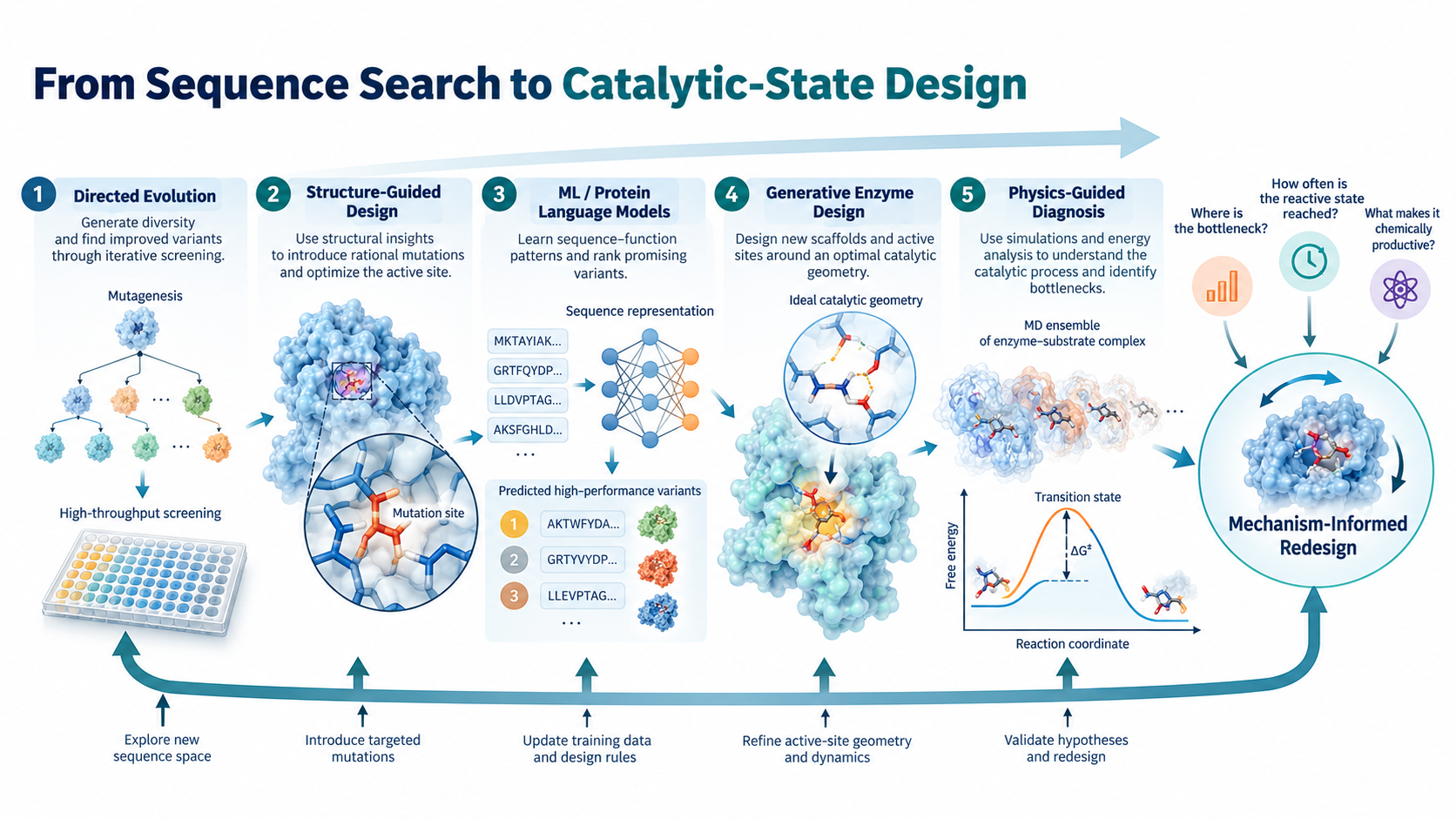
Machine learning may be applied for an efficient exploration of sequence space to find promising mutations for the experiment. It is necessary to understand the meaning of a score which is a separate task by itself. High score may mean something evolutionary, something about residue environment and compatibility, or something that has been learned from the activity data. Thus, similar scores may appear due to completely different molecular mechanisms. After selecting a mutation, we still need to investigate whether it improves substrate positioning, reduces structural reorganization, changes hydration, strengthens an electric field, or stabilizes a transition state.
SubTuner uses physics-guided modeling to link a proposed mutation to an explanation that can be tested. It turns ideas about heat stability, transition-state binding, and catalytic electric fields into numerical filters for screening candidates. In one benchmark, experiments showed that three of its ten proposed candidates were beneficial. This was a 30% hit rate, compared with 2.1% in the underlying experimental mutant pool. For our project, this approach is useful because each candidate is selected with a physical hypothesis about its effect. Simulations can then examine that hypothesis.
In the process of repeated cycles of computational evolution, AI.zymes takes into account several criteria. These include the use of Rosetta, ProteinMPNN, structure prediction, MD, transition-state recognition, stability estimation, and catalytic electric field. In their work on the promiscuous Kemp elimination activity of ketosteroid isomerase, the authors demonstrated a 7.7-fold enhancement after testing only seven variants. The results obtained indicate that analyzing only the structure can be insufficient. Protein dynamics and electrostatic interactions affect catalysis despite the fact that the model generating a particular sequence does not consider them.
In the 2026 MutexaGPT study, multiple LLM agents turn engineering ideas into physical measures, high-throughput simulations, and mutation proposals within a general workflow. Thus, enlarging a cavity or changing substrate positioning can be examined as a measurable molecular question. The framework includes cavity volume, substrate-positioning measures, electric fields, binding energies, folding free energies, and domain organization. It also considers cold-adaptation ideas. These measures let proposed changes be assessed through physical properties of the system.
In one cavity-engineering example, volumes estimated from static structures had almost no correlation with average volumes from MD ensembles. Protein motion exposed temporary or hidden cavities absent from the single structure. The enzyme is therefore better understood as a changing collection of structures within which catalysis occurs. This example and the other studies give us a basis for linking sequence selection to catalytic-state analysis and for examining the physical limitations involved.
Our Question: What Actually Limits PET Hydrolysis?
The following processes should happen before cleavage of the PET ester bond can occur. First, the enzyme has to contact a heterogeneous polymer surface, while a certain portion of the polymer should enter into the binding site with proper positioning. Second, the catalytic serine has to come close to the carbonyl at the PET bond with right distance and proper angle. Finally, the oxyanion hole and catalytic His-Asp network have to facilitate proton transfer and charge alterations during the formation of transition state.
Our PET-film assay measures the combined outcome of these events, so improving one requirement need not improve them all. To examine individual parts, we use docking to evaluate selected bound configurations and MD to follow configurations sampled over time. PRS analysis counts the relevant catalytic geometries, while quantum chemistry assesses the energy needed for chemical change in selected structures. Since the methods address different parts of hydrolysis, their rankings of mutations need not agree.
Defining the Scope of Computational Predictions
An equally important contribution of this work is to define what our computational descriptors can and cannot explain. PET depolymerization is an interfacial process that involves polymer morphology, surface accessibility, chain mobility, enzyme adsorption, product release, and chemical turnover. Because our molecular simulations begin from already bound PET-derived substrates, they describe only a subset of the full degradation process. PRS populations and calculated activation barriers should therefore be interpreted as mechanistic descriptors, rather than direct numerical predictors of PET-film degradation rates.
We view this distinction as essential for the responsible use of computational protein engineering. Different modeling approaches operate at different physical scales, and their conclusions should remain within the scope of the quantities they actually describe. A useful computational model does not need to reproduce every part of the experimental phenotype. Its value lies in generating an interpretable and testable hypothesis about the molecular process being studied.
References
- Jurich, C.; Shao, Q.; Ran, X.; Yang, Z.J. Physics-based modeling in the new era of enzyme engineering. Nat. Comput. Sci. 2025, 5, 279–291. https://doi.org/10.1038/s43588-025-00788-8
- Luo, S.; Liu, L.; Lyu, C.-J.; Sim, B.; Liu, Y.; Gong, H.; Nie, Y.; Zhao, Y.-L. Understanding the effectiveness of enzyme pre-reaction state by a quantum-based machine learning model. Cell Rep. Phys. Sci. 2022, 3, 101128. https://doi.org/10.1016/j.xcrp.2022.101128
- Wu, L.; Qin, L.; Nie, Y.; Xu, Y.; Zhao, Y.-L. Computer-aided understanding and engineering of enzymatic selectivity. Biotechnol. Adv. 2022, 54, 107793. https://doi.org/10.1016/j.biotechadv.2021.107793
- Jiang, Y.; Ding, N.; Shao, Q.; Stull, S.L.; Cheng, Z.; Yang, Z.J. Substrate positioning dynamics involves a non-electrostatic component to mediate catalysis. J. Phys. Chem. Lett. 2023, 14, 11480–11489. https://doi.org/10.1021/acs.jpclett.3c02444
- Sadiq, S.K.; Coveney, P.V. Computing the role of near attack conformations in an enzyme-catalyzed nucleophilic bimolecular reaction. J. Chem. Theory Comput. 2015, 11, 316–324. https://doi.org/10.1021/ct5008845
- Vaissier, V.; Sharma, S.C.; Schaettle, K.; Zhang, T.; Head-Gordon, T. Computational optimization of electric fields for improving catalysis of a designed Kemp eliminase. ACS Catal. 2018, 8, 219–227. https://doi.org/10.1021/acscatal.7b03151
- Bhowmick, A.; Sharma, S.C.; Head-Gordon, T. The importance of the scaffold for de novo enzymes: A case study with Kemp eliminase. J. Am. Chem. Soc. 2017, 139, 5793–5800. https://doi.org/10.1021/jacs.6b12265
- Madani, A.; Krause, B.; Greene, E.R.; et al. Large language models generate functional protein sequences across diverse families. Nat. Biotechnol. 2023, 41, 1099-1106. https://doi.org/10.1038/s41587-022-01618-2
- Lauko, A.; Pellock, S.J.; Sumida, K.H.; et al. Computational design of serine hydrolases. Science 2025, 388, eadu2454. https://doi.org/10.1126/science.adu2454
- Kim, D.; Woodbury, S.M.; Ahern, W.; et al. Computational design of metallohydrolases. Nature 2026, 649, 246-253. https://doi.org/10.1038/s41586-025-09746-w
- Braun, M.; Tripp, A.; Chakatok, M.; et al. Computational enzyme design by catalytic motif scaffolding. Nature 2026, 649, 237-245. https://doi.org/10.1038/s41586-025-09747-9
- Shao, Q.; Hollenbeak, A.C.; Jiang, Y.; Ran, X.; Bachmann, B.O.; Yang, Z.J. SubTuner leverages physics-based modeling to complement AI in enzyme engineering toward non-native substrates. Chem Catal. 2025, 5, 101334. https://doi.org/10.1016/j.checat.2025.101334
- Merlicek, L.P.; Neumann, J.; Lear, A.; et al. AI.zymes: A modular platform for evolutionary enzyme design. Angew. Chem. Int. Ed. 2025, 64, e202507031. https://doi.org/10.1002/anie.202507031
- Shao, Q.; Zhong, Y.; Stull, S.; et al. MutexaGPT: an intuition-to-design translator for physics-based enzyme engineering. Nat. Comput. Sci. 2026. https://doi.org/10.1038/s43588-026-01049-y