

Project Strategy: Two Discovery Routes, One Mechanistic Question
We searched for improved PET hydrolases through two complementary computational routes. Both proceeded to experimental testing and investigation of the same question about the mechanism behind the improvement.
Route A: Structure-Aware AI and Experiment-Informed Learning
In the first route, we searched local mutations in FAST-PETase with structure-aware graph learning.
A Geometric Vector Perceptron Graph Neural Network used three-dimensional information around individual residues to prioritize substitutions. We then combined experimental measurements with ESM2 embeddings, meta-learning, and Gaussian-process regression to refine our model of the relationship between sequence and function.
This was a combined search based on structure as well as activity. Hence, there was no need to completely depend on computation or go through every single sequence. Y87Q is an example of such promising sequences identified through this process.
Route B: Active-Site Design and Docking
For the second approach, mutants were created around the substrate binding site and active site region. Using structure-based modeling and docking analysis, we found that the S187Y mutant was a good candidate for our enzyme design. In evaluating these mutants, it became apparent that the docking score could not explain the catalytic activity of the mutants.
A Bottleneck-Guided Design–Build–Test–Diagnose–Learn–Redesign Cycle
Design-Build-Test-Learn cycles are commonly applied in synthetic biology. In enzyme engineering, the learn step can be seen as an empirical decision to pick the most active variant for another round of mutations. Improved performance could be achieved without identifying the particular microscopic feature which needs to be changed next.
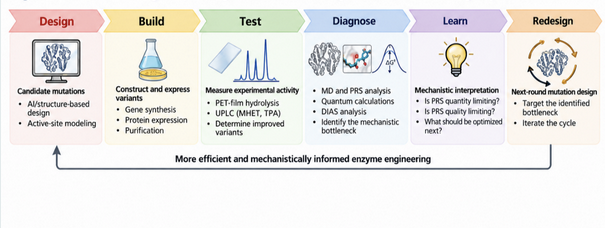
We added a diagnostic stage after experimental testing to understand the mechanism behind an observed improvement. In Design, we propose candidate sequences and hypotheses about how they might work. Build produces the enzymes, and Test checks whether the proposed improvements occur experimentally. For a successful variant, Diagnosis uses MD and PRS analysis to examine access to catalytic configurations. Quantum-chemical calculations and DIAS analysis then examine the associated energy changes and interactions. In Learn, we use these findings to identify the remaining physical bottleneck. This guides Redesign toward that limitation, rather than simply continuing the sequence search around the most active parent.
Both of these situations impact the way in which we design enzymes. In the former, when reaction-ready states are rare, we wish to boost the amount of PRS. This is possible through the means of alterations in substrate orientation, solvation, second shell effects, or protein dynamics. When these states are accessible but support chemistry poorly, we seek to improve the quality of PRS. Here, we consider the oxyanion hole, proton transfer abilities, electrostatics, substrate distortions, and transition state effects. Each computational method provides a different kind of evidence. We retain their separate diagnostic roles and do not combine their results into a single universal score.
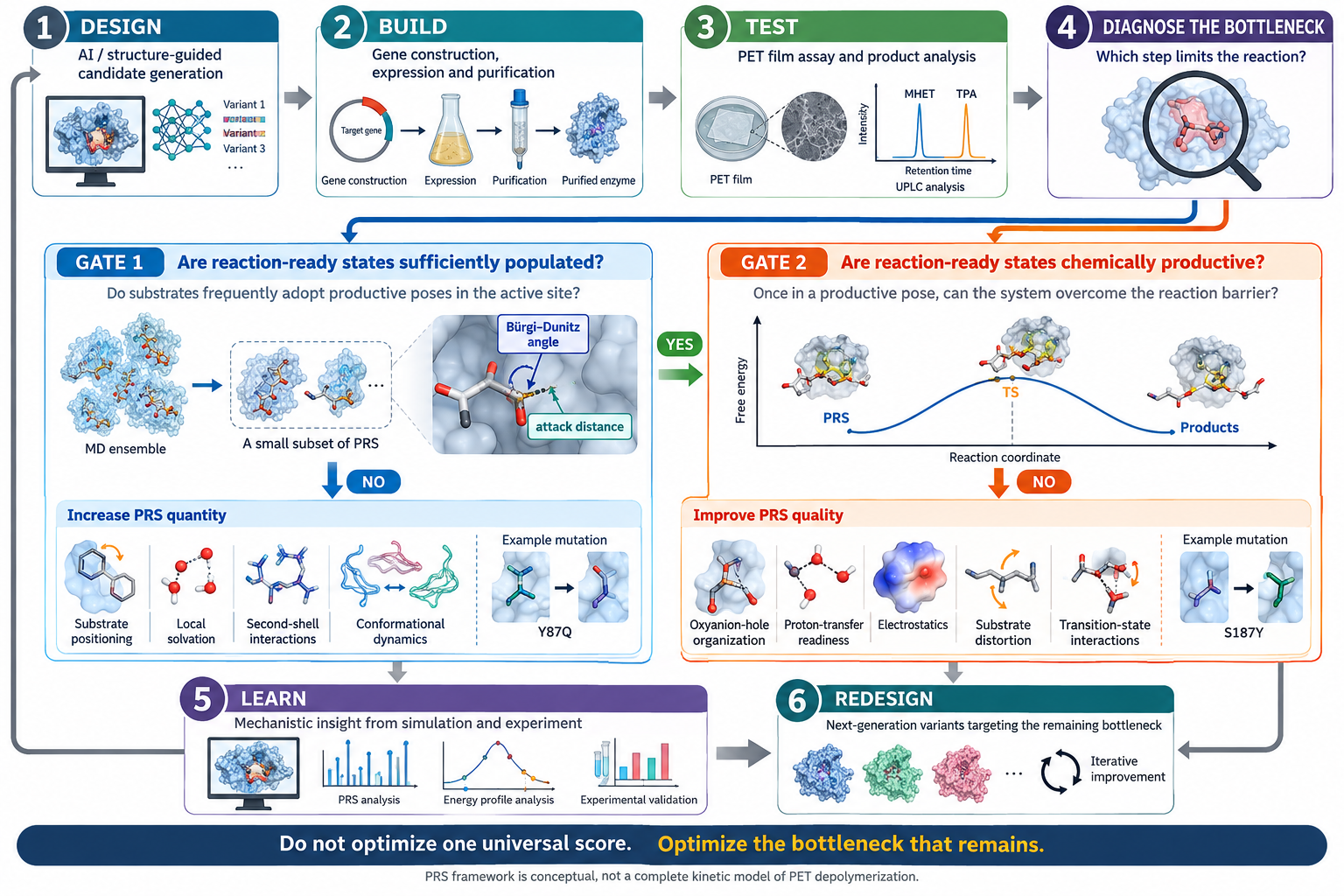
A Bottleneck-Guided Design–Build–Test–Diagnose–Learn–Redesign Cycle
Traditional Design-Build-Test-Learn cycle is a cornerstone of synthetic biology; in enzyme engineering, however, the "Learn" part can often be simplified to choosing the best active variant and using it as the template for the following cycle. Here we incorporate the Diagnose phase into this cycle so that the result of improvement will be converted into mechanistic information prior to the design phase.
Design produces mutation candidates and hypotheses about the mechanism. Build creates the new variant of the protein. Testing verifies the improvement of the enzyme activity. Diagnose identifies the physical reason for this change. For this purpose, MD and PRS analysis are used to study the accessibility of reaction-ready configurations of the enzyme, while quantum-chemical calculations and DIAS analysis help evaluate their energetic and interaction-level properties. Thus, the mechanistic interpretation becomes a starting point for learning and Redesigning the enzyme.
Indeed, such an approach immediately implies two potential diagnostic gates. If the reaction-ready states are not sufficiently occupied, then the next iteration of design should aim at increasing PRS quantity through optimization of substrate positioning, second-shell effects, local solvation effects, and conformational dynamics. When the reaction-ready states are already available but chemically unfavorable, then the next step should be PRS quality improvement with respect to oxyanion hole formation, proton transfer preparation, electrostatics, substrate distortions, and transition state interactions.
Hence, the importance of the framework proposed is not in the possibility to use PRS analysis and quantum chemistry to predict PET film degradation rates. It rather offers an insight into which property should be optimized in the next step.
References
- Jurich, C.; Shao, Q.; Ran, X.; Yang, Z.J. Physics-based modeling in the new era of enzyme engineering. Nat. Comput. Sci. 2025, 5, 279–291. https://doi.org/10.1038/s43588-025-00788-8
- Luo, S.; Liu, L.; Lyu, C.-J.; Sim, B.; Liu, Y.; Gong, H.; Nie, Y.; Zhao, Y.-L. Understanding the effectiveness of enzyme pre-reaction state by a quantum-based machine learning model. Cell Rep. Phys. Sci. 2022, 3, 101128. https://doi.org/10.1016/j.xcrp.2022.101128
- Wu, L.; Qin, L.; Nie, Y.; Xu, Y.; Zhao, Y.-L. Computer-aided understanding and engineering of enzymatic selectivity. Biotechnol. Adv. 2022, 54, 107793. https://doi.org/10.1016/j.biotechadv.2021.107793
- Jiang, Y.; Ding, N.; Shao, Q.; Stull, S.L.; Cheng, Z.; Yang, Z.J. Substrate positioning dynamics involves a non-electrostatic component to mediate catalysis. J. Phys. Chem. Lett. 2023, 14, 11480–11489. https://doi.org/10.1021/acs.jpclett.3c02444
- Sadiq, S.K.; Coveney, P.V. Computing the role of near attack conformations in an enzyme-catalyzed nucleophilic bimolecular reaction. J. Chem. Theory Comput. 2015, 11, 316–324. https://doi.org/10.1021/ct5008845
- Li, A.; Song, Y.; Hu, J.; Zhang, H.; Li, Z.; Tang, J.; Huang, H.; Li, S.; Li, X. Integrating graph learning and meta-learning to enhance PET hydrolase activity at elevated temperatures. Cell Rep. Phys. Sci. 2026, 7, 103037. https://doi.org/10.1016/j.xcrp.2025.103037
- Zheng, Y.; Li, Q.; Liu, P.; Yuan, Y.; Dian, L.; Wang, Q.; Liang, Q.; Su, T.; Qi, Q. Dynamic docking-assisted engineering of hydrolases for efficient PET depolymerization. ACS Catal. 2024, 14, 3627–3639. https://doi.org/10.1021/acscatal.4c00400
- Burgin, T.; Pollard, B.C.; Knott, B.C.; Mayes, H.B.; Crowley, M.F.; McGeehan, J.E.; Beckham, G.T.; Woodcock, H.L. The reaction mechanism of the Ideonella sakaiensis PETase enzyme. Commun. Chem. 2024, 7, 65. https://doi.org/10.1038/s42004-024-01154-x
- Bürgi, H. B.; Dunitz, J. D.; Lehn, J. M.; Wipff, G. Stereochemistry of Reaction Paths at Carbonyl Centres. Tetrahedron 1974, 30, 1563–1572. https://doi.org/10.1016/S0040-4020(01)90678-7
- Zholdassov, Y.S.; Yuan, L.; Garcia, S.R.; Kwok, R.W.; Boscoboinik, A.; Valles, D.J.; Marianski, M.; Martini, A.; Carpick, R.W.; Braunschweig, A.B. Acceleration of Diels–Alder reactions by mechanical distortion. Science 2023, 380, 1053–1058. https://doi.org/10.1126/science.adf5273
- Bickelhaupt, F.M.; Houk, K.N. Analyzing reaction rates with the distortion/interaction–activation strain model. Angew. Chem. Int. Ed. 2017, 56, 10070–10086. https://doi.org/10.1002/anie.201701486
- Vaissier, V.; Sharma, S.C.; Schaettle, K.; Zhang, T.; Head-Gordon, T. Computational optimization of electric fields for improving catalysis of a designed Kemp eliminase. ACS Catal. 2018, 8, 219–227. https://doi.org/10.1021/acscatal.7b03151
- Bhowmick, A.; Sharma, S.C.; Head-Gordon, T. The importance of the scaffold for de novo enzymes: A case study with Kemp eliminase. J. Am. Chem. Soc. 2017, 139, 5793–5800. https://doi.org/10.1021/jacs.6b12265
- Shao, Q.; Hollenbeak, A.C.; Jiang, Y.; Ran, X.; Bachmann, B.O.; Yang, Z.J. SubTuner leverages physics-based modeling to complement AI in enzyme engineering toward non-native substrates. Chem Catal. 2025, 5, 101334. https://doi.org/10.1016/j.checat.2025.101334
- Merlicek, L.P.; Neumann, J.; Lear, A.; et al. AI.zymes: A modular platform for evolutionary enzyme design. Angew. Chem. Int. Ed. 2025, 64, e202507031. https://doi.org/10.1002/anie.202507031
- Shao, Q.; Zhong, Y.; Stull, S.; et al. MutexaGPT: an intuition-to-design translator for physics-based enzyme engineering. Nat. Comput. Sci. 2026. https://doi.org/10.1038/s43588-026-01049-y