
Mechanism#
Our CRISPRi-based continuous selection is designed to evolve protein nanocompartments. By coupling cargo sequestration to the restoration of kanamycin resistance, it uses cell growth to select for improved capture.
The continuous evolution campaign has not yet been run. Capturing either dCas9 or its sgRNA can restore resistance; this selection does not by itself demonstrate co-encapsulation.
How the selection works
01
Silence
dCas9 binds inside the resistance gene and throttles it.
A catalytically dead Cas9, guided into the kanamycin-resistance ORF, obstructs rather than cuts. Elongating RNA polymerase collides with the R-loop, is delayed, and eventually displaces it.
By targeting the gene's ORF rather than its promoter, dCas9 reduces resistance instead of switching it off completely. This creates a graded response. We choose the guide to bring resistance just below the threshold needed to grow in kanamycin.
Fig 1. dCas9·sgRNA bound in the resistance ORF.
02
Diversify
MutaT7 targets mutation to the shell cassette.
A cytidine deaminase fused to T7 RNA polymerase mutates processively from a T7 promoter to its terminator. The encapsulin ORF is the only sequence inside that window.
The host genome lies outside the targeted mutation window; background replication errors remain possible. Diversity accumulates in growing culture — no transformation rounds, no step performed in a tube.
Fig 2. T7 polymerase tracking the encapsulin cassette, leaving deamination events behind it.
03
Encapsulate
A shell that captures the repressor restores resistance.
240 subunits assemble into a T=4 compartment 42 nm across. dCas9 carries the encapsulin's native cargo-loading peptide; the sgRNA carries a boxB hairpin, caught by a λN peptide grafted onto the inner surface. Capturing either half clears the gene.
Growth rate is then a readout of encapsulation efficiency, and continuous culture integrates that margin over many generations. Raising the kanamycin concentration between passages raises the fraction that must be captured.
Fig 3. Assembly around the repressor complex. Molecular sizes are to scale relative to each other; the cell and plasmids are schematic. ChimeraX molecular views remain fixed as the shell rotates. PDB 5F9R illustrates the Cas9 fold; engineered fusions are not modeled.
The circuit#
A catalytically dead Cas9 (dCas9) is directed by an sgRNA into the open reading frame (ORF) of the kanamycin-resistance gene on the selection plasmid. It obstructs transcription without cleaving DNA. The guide is chosen to lower resistance just below the threshold needed for growth at the selected kanamycin concentration.
Position of the guide#
Unlike standard promoter-targeting CRISPRi, our circuit targets the ORF to produce the graded repression needed for continuous selection. The two target positions differ:1
| Target in the promoter | Target inside the ORF | |
|---|---|---|
| Mechanism | RNA polymerase cannot bind an occupied promoter | RNA polymerase collides with the R-loop and can displace dCas9 |
| Escape route | diffusion only | processive read-through |
| Repression | near-absolute | partial |
| Depends on [dCas9]? | yes | no, once the target is saturated |
| Tunable by guide length? | weakly | yes, continuously |
Inside a gene body, the complementarity between guide and target sets the probability that RNA polymerase displaces dCas9 during a transcription attempt, while spontaneous unbinding is negligible. Expression is
Here, \(c\) is the expression level under repression, \(c_0\) is the unrepressed expression level, \(P(\text{bound})\) is the probability that dCas9 occupies the target site, and \(P(\text{stop})\) is the probability that an occupied site stops an approaching RNA polymerase.
Once dCas9 saturates the site, \(P(\text{bound}) \to 1\) and relative expression \(c/c_0\) equals the passage probability, \(r\):
The passage probability is the fraction of transcription attempts that pass the dCas9 roadblock. In this model it is set by guide–target complementarity. Reported values range from \(r = 0.026 \pm 0.003\) at full complementarity to \(0.056 \pm 0.001\) with six mismatches.
Graded readout#
Absolute repression gives a binary live/die outcome without a gradient for selection. With partial repression, small improvements in sequestration give small improvements in growth rate, and continuous culture accumulates these over many generations.
Noise#
Titrating dCas9 with an inducer introduces substantial cell-to-cell variation in the intermediate expression range where selection operates. Our design instead aims to keep the DNA target saturated with dCas9 and tune repression through guide complementarity. While the site remains saturated, fluctuations in dCas9 concentration have little effect on resistance-gene expression.
Vigouroux and colleagues measured approximately constant noise of 0.3 across their guide-tuned knockdown range, similar to constitutive genes in wild-type E. coli.1 Noise here means the standard deviation of single-cell expression divided by its mean. This is the basis for our design; noise in our selection circuit has not yet been measured.
Regulation#
dCas9 and the sgRNA are under two orthogonal small-molecule-inducible regulators, VanRAM and PhlFAM, which had the largest dynamic range and the best orthogonality of the twelve tested.2 Guide complementarity and inducer concentration are independent settings: the first sets the passage probability, the second the amount of repressor. Both can be changed during culture.
Alternative readout: creT#
The same principle can be applied to a toxin. In the archaeal creTA system, the creA RNA represses creT, a small RNA toxin that sequesters rare codons. Placing the protospacer of the sgRNA in the 5′ UTR of the repressor that controls creT gives a positive selection in which encapsulation of dCas9 or the sgRNA relieves toxin repression and permits growth (Fig S1). Chen et al. used a creT-based selection to evolve Cas12a.3 It is kept as an alternative to the kanR circuit.
Sequestration restores expression#
The 240 encapsulin subunits assemble into a T=4 icosahedral compartment of 42 nm, about twice the span of the complex. Either component can be captured: dCas9 through a cargo-loading peptide, or the sgRNA through a boxB hairpin (see Design for the OR gate).
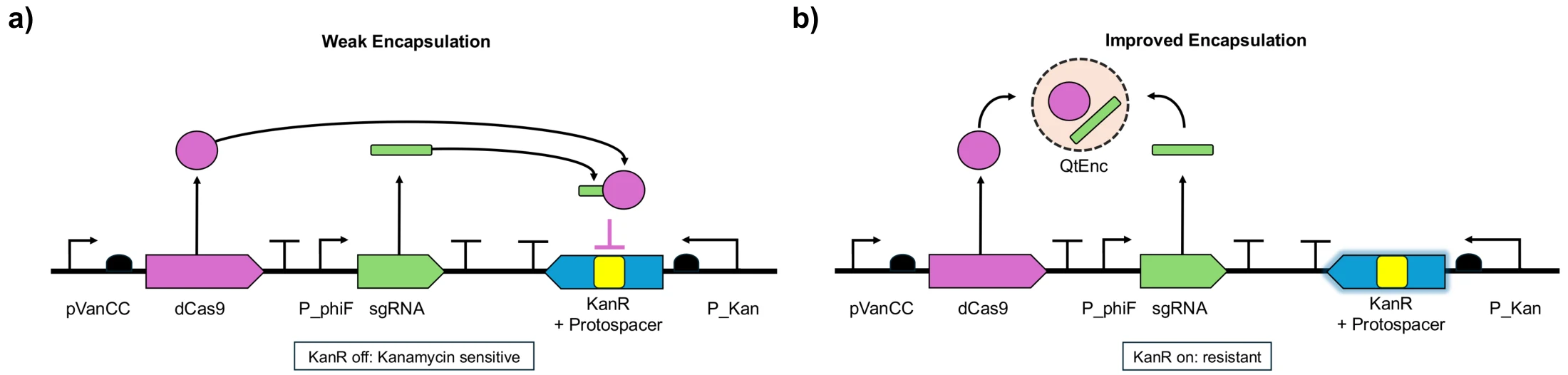
Fig 4. (a) Weak or absent encapsulation: free dCas9·sgRNA represses kanR; KanR is off and the cell is kanamycin-sensitive. (b) Improved encapsulation: capture of dCas9 or its sgRNA relieves repression; KanR is on and resistance is restored. Full caption under Results.
The two stringency knobs#
Selection stringency is set by the guide length and the kanamycin concentration.
Guide length sets the baseline. A truncation series (non-targeting, 10, 11, 14, 17 and 20 nt of complementarity) covers a range of passage probabilities. The working guide is the one whose unrescued residual resistance lies just below the survival threshold, so that a small improvement in capture determines growth.
Kanamycin concentration is increased stepwise. Raising it between passages raises the resistance a cell must reach, and therefore the fraction of repressor it must sequester. Finer adjustment is possible by replacing the guide with a longer one, alone or together with a higher dose.
Constructs#
The circuit is split across two compatible plasmids: the mutation plasmid, carrying the MutaT7 machinery and the mutable encapsulin cassette, and the selection plasmid, carrying dCas9, the sgRNA and the resistance gene. Maps are on the Constructs page.
Carries the MutaT7 RNA polymerase–deaminase fusion and the QtEncapsulin open reading frame flanked by a T7 promoter and a T7 terminator. This cassette is the only hypermutated sequence in the cell.
Carries dCas9, the sgRNA cassette and the kanamycin-resistance gene with its target site, on a pSC101 backbone outside the T7 transcription unit.
Escape routes
Any mutation that reduces dCas9 or sgRNA expression restores resistance without improving encapsulation and is enriched equally. Both are therefore held on the non-mutable plasmid, outside the T7 transcription unit.4
Loss of shell expression is the corresponding failure on the mutation plasmid. A population whose resistance has recovered while its encapsulin cassette carries a frameshift has escaped selection and has not evolved.
-
Vigouroux, Oldewurtel, Cui, Bikard & van Teeffelen, Molecular Systems Biology 14, e7899 (2018), doi:10.15252/msb.20177899. The displacement model, the mismatch titration and the noise measurements are from this work. ↩↩
-
Meyer et al., Nat. Chem. Biol. 15, 196 (2019). ↩
-
Chen et al., Adv. Sci. 12, e17105 (2025). ↩
-
This placement protects against hypermutation but not against errors of the host polymerase. The selection plasmid is therefore re-sequenced periodically during passaging. ↩