
Design#
QtEncapsulin#
The shell is QtEncapsulin (QtEnc), the encapsulin of Quasibacillus thermotolerans. Its native structure is deposited as 6NJ8.1
- Subunits: 240 per shell.
- Symmetry: T=4 icosahedral compartment.
- Diameter: approximately 42 nm.
- Mass: approximately 7.7 MDa.
- Cargo-loading sites: one on the inner face of each subunit.
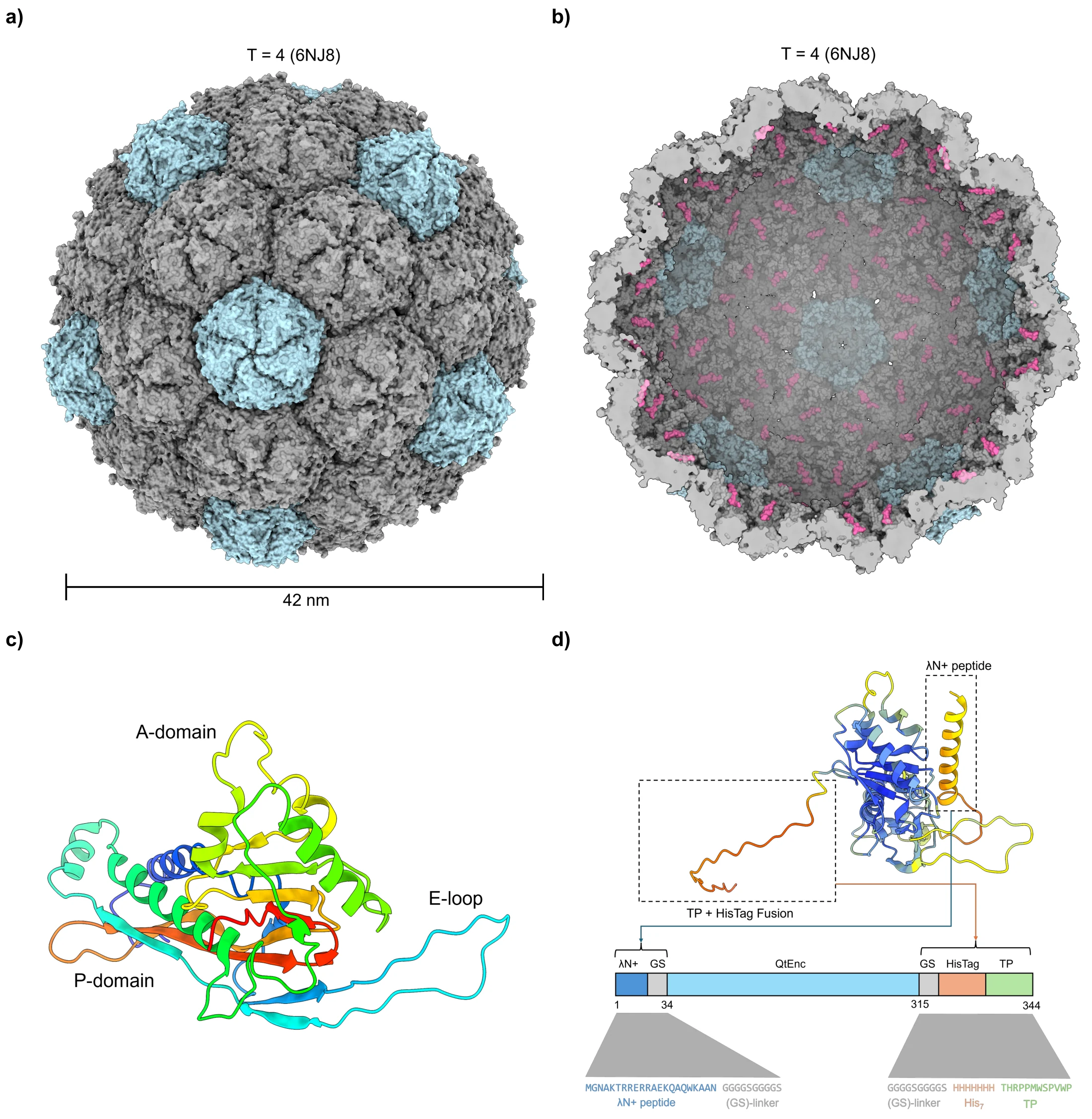
Fig 1. QtEnc (6NJ8) and the engineered subunit: λN⁺ on the lumenal face, HisTag and targeting peptide (TP) on the outer face, each joined by a GS linker. Full caption under Results.
We chose QtEnc for four reasons.
- Size. A T=4 shell can accommodate a dCas9 ribonucleoprotein, whereas a T=1 cage of 60 subunits cannot.
- Permeability. Cargo of 14–482 kDa enters pre-assembled shells in a single mixing step, without disassembly, co-expression tuning or a triggering component. Capture therefore does not need to coincide with assembly.
- Minimal loading chemistry. The core motif of the CLP is five residues
(
TVGSL) and works at either terminus, so it is unlikely to interfere with folding of the cargo. - Tolerance to evolution. QtEnc has been evolved in a life–death selection and tolerates 13-residue deletions in a vertex-lining loop.
Wild-type QtEnc has no affinity for nucleic acids, and pore engineering does not change this. An RNA-binding element therefore has to be introduced before evolution can improve RNA loading.
Cargo handles#
The cargo is the complex of dCas9 and its sgRNA. Each component has its own handle.
dCas9 is fused at its C-terminus to the cargo-loading peptide (IMEF in the construct names). The CLP docks into the binding groove on the lumenal face of each of the 240 protomers. This uses the native loading chemistry of QtEnc and the five-residue core is unlikely to disturb dCas9 folding.
The sgRNA carries boxB hairpins, which bind the arginine-rich λN⁺ peptide grafted onto the interior surface of the shell. In the scaffold, boxB replaces the validated MS2 stem-loop insertion sites, in both the stem-loop and the tetraloop (Fig S2). Hilvert and co-workers gave a non-viral cage mRNA recognition by appending cationic peptides including λN⁺, which line the lumenal edge of the shell openings. A lysine-to-arginine substitution in λN⁺ raises boxB affinity about threefold and is available if capture is too weak.
Outer-surface modifications#
The first designs carried a His-tag and a targeting peptide on the outside of the shell, for purification and delivery. The His-tag-bearing shell partitioned into the insoluble fraction (Results). It was not resolved whether the tag, the peptide or the combination was responsible, so the designs used for evolution carry no external modification. Variants with the targeting peptide and no His-tag are built in parallel. Tolerance of outer-surface fusions is therefore a further property that can be selected.
OR gate#
The two handles are orthogonal, and the selection treats them as an OR gate: capturing either the sgRNA or dCas9 breaks up the complex and rescues the cell.
OR gate and AND gate
An AND gate, requiring capture of both components, would test co-encapsulation more directly, but a shell that captures neither component well would have no gradient towards capturing both. The OR gate rewards partial progress along either axis.
As a consequence, variants that capture only one handle can be enriched instead of true co-encapsulation. These are distinguished by the co-encapsulation assays, not by the selection.
Design constraints#
Only the shell evolves. Any other element of the circuit that can mutate to restore resistance will do so faster than the shell. This requires the two-plasmid split described in Constructs.
Repression is graded. Targeting the resistance ORF rather than its promoter reduces expression without switching it off completely. Mechanism describes how guide truncation tunes this response.
dCas9 expression. Repression becomes independent of dCas9 concentration once the target is saturated, which favours high expression. dCas9 overexpression is also reported to be toxic in E. coli, so the working range lies above saturation and below toxicity.
Shell assembly. Selection can only act on capture once cages form in the cell. Cage assembly is therefore confirmed independently, by electron microscopy and chromatography (see the outlook).
-
Giessen et al., eLife 8, e46070 (2019), doi:10.7554/eLife.46070. ↩