
Constructs#
Constructs and their status. The design is described under Design and Mechanism; the full inventory with backbones and markers is Table S1.
Shell expression plasmids#
All in pET-Duet-1 (ampicillin). The shell carries a lumenal λN⁺ peptide (GS linker) as RNA handle; TP is the outer-surface targeting peptide.
| Construct | Shell | Second cassette | Status |
|---|---|---|---|
p_f008 |
QtEnc, no His-tag or TP | — | Verified |
p_f009 |
QtEnc + TP | — | Verified |
p_f010 |
QtEnc (boxBr + λN) | mScarlet (FLAG + boxBr) | Verified |
p_f011 |
QtEnc (boxBr + λN + TP) | mScarlet (FLAG + boxBr) | Verified |
p_f012–p_f017 |
six combinations of boxBr, λN and TP | dCas9 (FLAG + IMEF + boxBr) | In assembly |
mScarlet (26.7 kDa) is a fluorescent cargo reporter used to follow co-elution with the shell peak. Masses used for gel interpretation:
| Species | Mass |
|---|---|
| QtEncapsulin monomer | 32.2 kDa |
| QtEncapsulin + peptide fusion | 34.1 kDa |
| mScarlet | 26.7 kDa |
| Assembled T=4 shell | ~7.7 MDa |
Mutation plasmids#
Built on the MutaT7 backbones pDB004 and pDB006. The QtEnc open reading frame sits between a T7 promoter and terminator.
| Construct | Content | Status |
|---|---|---|
p_m005 |
QtEnc, no TP or His-tag | Verified |
p_m006 |
QtEnc + TP | Verified |
p_m007 |
QtEnc + TP + His-tag | Verified |
p_m004, p_m008 |
stop-codon reporters for MutaT7 validation | Verified |
Selection plasmids#
pSC101 backbone (kanamycin, plus a tetracycline-resistance cassette for assembly), built by Golden Gate from five parts. dCas9 and the sgRNA are under VanRAM and PhlFAM control.
| Construct | Complementarity | Role | Status |
|---|---|---|---|
p_s002_NT_TcR |
none | Non-targeting control, unrepressed output | In assembly |
p_s002_10nt_TcR |
10 nt | Weakest repression | In assembly |
p_s002_11nt_TcR |
11 nt | In assembly | |
p_s002_14nt_TcR |
14 nt | In assembly | |
p_s002_17nt_TcR |
17 nt | In assembly | |
p_s002_20nt_TcR |
20 nt | Full complementarity, strongest repression | In assembly |
Four of five junctions form in two independent reactions; the TcR-to-backbone junction is the open step (Table S2, outlook).
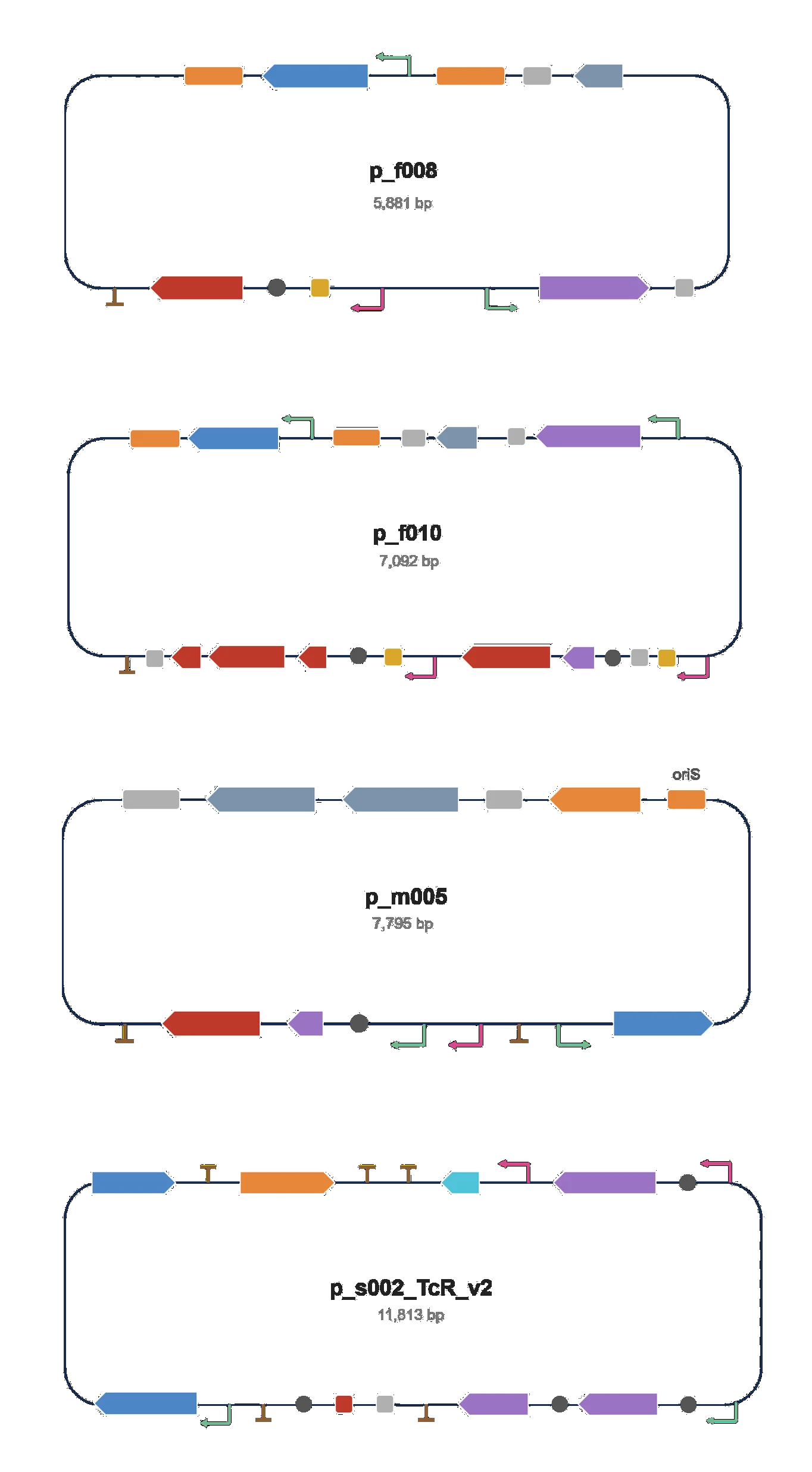
Fig 1. Maps of p_f008 (a), p_f011 (b), p_m005 (c) and the
selection plasmid s_002_TcR_creT_v2 (d).

Fig 2. KanR-targeting sgRNA with the spacer and the boxB insertion sites in the scaffold.
Handles#
Protein. dCas9 carries the cargo-loading peptide (IMEF) at its C-terminus;
the core motif is five residues, TVGSL.
RNA. boxB hairpins in the sgRNA stem-loop and tetraloop, caught by λN⁺ on the shell interior. A known lysine-to-arginine substitution in λN⁺ raises boxB affinity roughly threefold if capture proves too weak.
Controls#
- Non-targeting guide (
s002_NT): defines the unrepressed output. Survival at a kanamycin dose it cannot tolerate indicates a resistance mechanism independent of the selection. - Shell-free: dCas9 and guide without encapsulin. Defines maximal repression without rescue.
- Handle-free shell: no λN graft and no CLP on dCas9. Separates handle-mediated capture from non-specific sequestration.
- Single-handle constructs: λN without the CLP, and the converse
(
p_f014–p_f017). They show which arm of the OR gate is responsible for any rescue.
Provenance#
Addgene: pdCas9-bacteria (dCas9), pSC101-T7-T3RNAP and the pDB series (MutaT7).
Synthetic fragments from Twist Bioscience. Maps and sequences are kept in
Benchling; see Attributions.